
Dog Training Games for Group Classes: 12 Fun Activities That Build Real Skills
Estimated reading time: 12 minutes
Quick Answer: The best dog training games for group classes are short, skill-specific, and easy to run with multiple dogs in one space. Games like “musical sits,” “recall relay,” “pass the puppy,” “leave it” challenges, and “find your human” teach core behaviors while keeping dogs engaged and owners laughing. Every game should use positive reinforcement, respect each dog’s threshold, and match the class’s overall skill level.
Anyone who has taught or attended a group dog training class knows the moment: half the dogs are sniffing the floor, one is barking at the door, another is spinning at the end of the leash, and the instructor is trying to explain the difference between luring and capturing. That is when dog training games for group classes become the difference between a session that works and a session that falls apart. Games change the energy. They give dogs a job, give owners something to do with their hands, and turn abstract training concepts into moments everyone can see working.
I have run group classes and assisted in puppy socials long enough to know that the games themselves are not magic. What matters is how they are structured, when they are introduced, and whether they are adapted to the specific dogs in the room. A recall game with three over-aroused adolescents is chaos. The same game with three calm puppies is a breakthrough. Here is how to pick the right games and run them well.
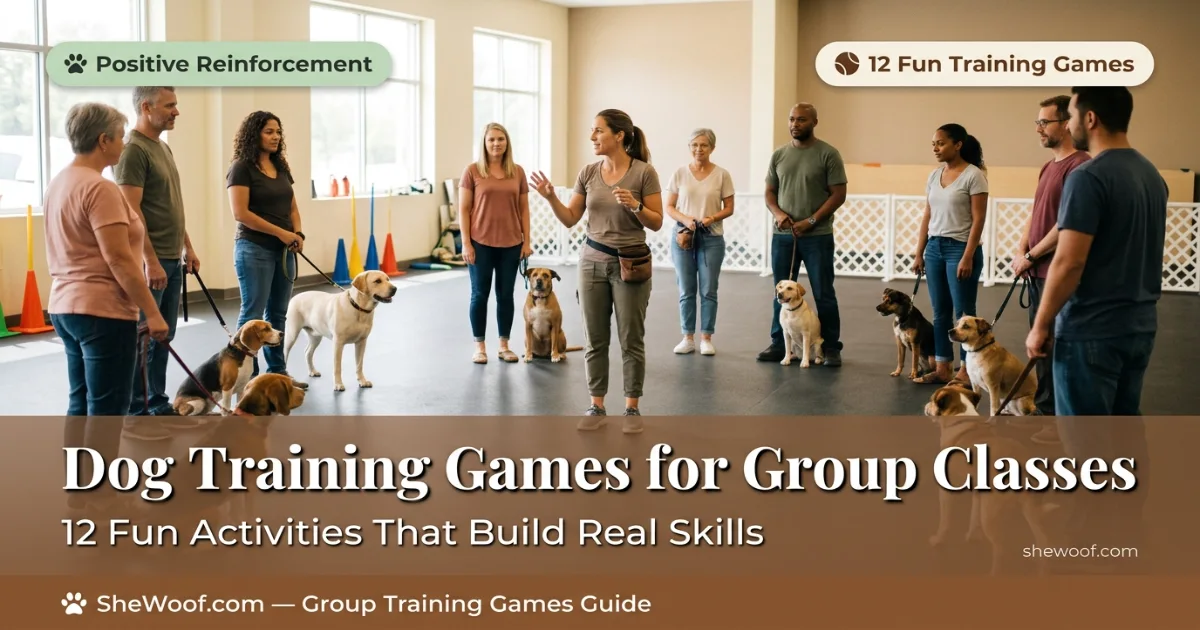
Why Do Games Work Better Than Drills in Group Classes?
Games work because they change the emotional context of training. When a dog is playing, their brain releases dopamine — the same neurochemical that reinforces learning. This means a game-based training session does more than keep dogs entertained; it makes the learning stick. A dog who learns “sit” while playing a game remembers it better than a dog who learns it through twenty repetitive reps with no variation.
Games also solve a problem unique to group classes: the environment is full of distractions. Other dogs, other owners, strange smells, and strange sounds all compete for your dog’s attention. Traditional drills try to suppress that distraction. Games use it. A dog who learns to focus on their owner while playing a game in a room full of other dogs has learned something far more valuable than a dog who can only focus in a quiet living room.
For owners, games also teach the mechanics of training without the pressure of “getting it right.” When you are playing “musical sits,” you are not thinking about marker timing or reward schedules. You are just enjoying your dog. Ironically, that often produces better training results than a focused drill session. Relaxed owners have better timing, clearer cues, and more patience.
What Kinds of Games Work Best in Group Settings?
Not every training game works in a group. The best games for group classes share a few traits. They can be run with multiple dogs at once or in quick rotations. They do not require dogs to interact directly unless social skills are the specific focus. They are easy to reset when something goes wrong. And they give every dog a fair chance to succeed, regardless of breed, age, or temperament.
Games that create direct competition between dogs are generally best avoided. They can trigger resource guarding, reactivity, or frustration. Games that involve chasing — like fetch in a group — can escalate into over-arousal and rough play. Games that require dogs to be close together in tight spaces should only be run when the class has been screened for compatibility.
12 Dog Training Games for Group Classes
These games are organized loosely from lowest to highest difficulty. Beginner classes and puppy classes should stay with the first four or five. Advanced classes can use all twelve.
1. Musical Sits
Owners walk their dogs in a circle while music plays. When the music stops, every dog must sit. The last dog to sit is not eliminated — this is a training class, not a competition. Instead, everyone gets a treat for a successful sit, and the game continues. This builds fast response to the “sit” cue, teaches focus around other dogs, and is almost impossible to lose at.
2. Pass the Puppy (Puppy Classes Only)
Owners sit in a circle and gently pass puppies from person to person, one at a time. Each person holds the puppy for a few seconds, gives a treat, and passes them on. This game teaches puppies that being handled by strangers is safe and rewarding. It also helps owners practice calm, supportive handling. Never force a puppy who is uncomfortable — if a puppy is stressed, the handler should hold them quietly until they settle, then pass them back.
3. Recall Relay
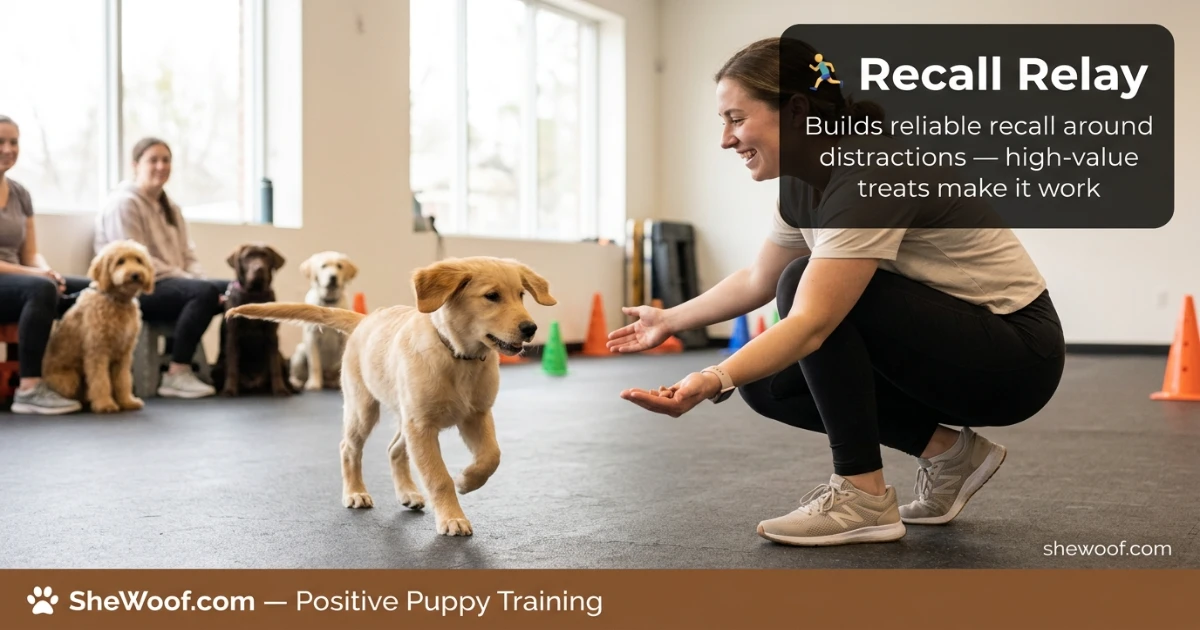
Owners line up on one side of the room with their dogs. One at a time, an owner calls their dog from the opposite end of the room. When the dog arrives, the owner rewards, then sends the dog back with a helper. This builds a reliable recall around distractions and gives dogs practice running toward their owner — not away. Keep sessions short and use high-value treats.
4. Name Game
Each owner says their dog’s name once and waits for eye contact. The moment the dog looks, mark and reward. Repeat. This simple game builds the foundation of attention and is especially useful for puppies who are still learning their name. In a group class, it teaches dogs to respond to their owner’s voice even in a busy room.
5. Find Your Human
Owners stand in a wide circle. One at a time, an owner steps out of the circle and hides behind another owner or an object. The dog is released to find them. When the dog finds their person, they get a reward and praise. This teaches scent-based recall and reinforces the idea that coming when called always leads to something good.
6. Leave It Temptation Line
Owners walk their dogs past a line of treats or toys placed on the floor. The dog must ignore the items and focus on their owner. Each successful pass earns a reward from the owner’s hand. This teaches impulse control and “leave it” in a controlled but stimulating environment.
7. Settle on a Mat
Each owner places a mat on the floor and rewards their dog for lying calmly on it. As the game progresses, owners add distractions — other dogs walking past, owners talking, treats dropping nearby. The dog must remain on the mat. This is one of the most useful skills for real life, and it can be run as a quiet parallel activity while other games are happening.
8. Wait at the Door
Owners practice having their dog wait at a doorway while other teams pass through. The dog must remain in place until released. This teaches door manners and impulse control in a real-world context. Run this game one team at a time to avoid crowding.
9. Spin the Cue
Owners stand in a circle with their dogs. One owner calls out a cue — sit, down, spin, touch, whatever the class has been practicing — and everyone practices it at the same time. This builds response speed and generalization across different cues in a busy environment. Rotate who gets to choose the cue so every owner participates.
10. Temptation Alley
Create a corridor between two lines of tempting items — toys, treats, bowls of food. Each owner walks their dog down the corridor, rewarding their dog for ignoring the items and focusing forward. This is a more advanced version of “leave it” and is best used with dogs who already have solid impulse control.
11. Trick Station Rotation
Set up three or four stations around the room with different tricks or skills to practice — one for spins, one for paw targets, one for rollovers, one for “back up.” Owners rotate through stations with their dogs, spending two to three minutes at each. This keeps dogs engaged, teaches variety, and prevents boredom.
12. Quiet Time Challenge
Owners sit with their dogs and practice calm behavior while distractions happen around them. Instructor walks through the room, other owners chat, treats are tossed nearby — the dog must remain relaxed and focused. This is the ultimate test of a dog’s ability to settle in a busy environment. Reward duration, not just the behavior.
How Do You Choose the Right Games for Your Class?
The games you choose should depend on the class’s overall goal and the dogs in the room. Here is a quick guide.
| Class Type | Best Games | Why |
|---|---|---|
| Puppy class (8–16 weeks) | Pass the Puppy, Name Game, Musical Sits | Builds socialization and early focus |
| Beginner obedience | Recall Relay, Leave It Temptation Line, Settle on a Mat | Core skills with low distraction |
| Intermediate obedience | Temptation Alley, Wait at the Door, Spin the Cue | Builds focus around real-world triggers |
| Reactive dog class | Settle on a Mat, Quiet Time Challenge, parallel sniffing games | Low-pressure exposure without direct interaction |
| Advanced / sport class | Find Your Human, Trick Station Rotation, Recall Relay variations | Builds precision and generalization |
What Are Common Mistakes When Running Group Training Games?
The most common mistake is running games that are too long. A three-minute game that ends with everyone successful is better than a ten-minute game that ends with tired dogs and frustrated owners. Watch the group. When focus dips, stop and reset.
Another mistake is letting the environment become too stimulating. Games that involve lots of movement, noise, or excitement can push dogs over threshold. Once a dog is over-aroused, they cannot learn. End the game before that happens, even if the group is having fun.
A third mistake is ignoring individual differences. Not every dog in the class will be able to play every game. A shy rescue dog may need to sit out a fast-paced recall relay. A reactive dog may need extra distance or a visual barrier. Adapting the game for individual dogs is not special treatment — it is good teaching.
Finally, some instructors let games become competitive. This can be motivating for confident teams but demoralizing for beginners and stressful for anxious dogs. Keep games cooperative. Everyone wins when everyone practices.
What About Puppy vs Adult vs Senior Dogs?
Puppies have short attention spans and tire quickly. Games for puppies should be under three minutes and focused on socialization, name recognition, and basic cues. Puppy classes benefit from frequent breaks and slow introductions to new environments.
Adult dogs can handle longer games and more complex skills. They often need more mental engagement than puppies because their energy is less about novelty and more about purpose. Games that involve problem-solving — like Find Your Human or Trick Station Rotation — work especially well for adults.
Senior dogs may have physical limitations that require adaptations. Games should be low-impact, short, and considerate of any arthritis or vision/hearing loss. For a senior dog, “Quiet Time Challenge” and gentle “Settle on a Mat” work better than fast-paced recall relays. Keep treats soft if the dog has dental issues.
- Bring high-value treats your dog does not get at home.
- Arrive early so your dog can settle before the class begins.
- Practice the games at home between classes — generalization takes repetition.
- Watch your dog for signs of stress and step out if they need a break.
- Celebrate small wins. Progress in group classes is often slower than private training.
- Bring water and a bowl. Group classes are mentally tiring.
- If a game is not working for your dog, tell the instructor. Adaptations are normal.
How Much Do Group Training Classes Cost?
- Puppy kindergarten (6 weeks): $100–$200
- Basic obedience (6–8 weeks): $120–$250
- Intermediate/advanced (6–8 weeks): $150–$300
- Reactive dog class (6 weeks): $200–$400
- Drop-in play/training sessions: $20–$40 per session
Prices vary by region, class size, and instructor credentials. A class with fewer than six dogs usually costs more per session. Certification from organizations like the CCPDT or KPA generally indicates higher-quality instruction. If a class is dramatically cheaper than the average, ask about the instructor’s training and the class structure before signing up.
When Should You Call a Professional Trainer?
Group classes work well for most dogs, but some situations need one-on-one attention. If your dog is reactive toward other dogs or people, a group class may be too much at first. A certified behavior consultant can assess your dog and recommend whether a group setting is appropriate or whether private sessions would be more successful.
If your dog has been through a group class and is not improving, private training may be more efficient. Group classes teach foundational skills, but individualized training can target specific behavioral issues that a general curriculum does not address.
- Dog training games for group classes work best when they are short, skill-specific, and cooperative rather than competitive.
- Popular games include Musical Sits, Recall Relay, Pass the Puppy, Leave It Temptation Line, and Settle on a Mat.
- Games should match the class’s overall goal — puppy socialization, beginner obedience, reactive dog work, or advanced sport training.
- Watch for signs of stress and stop the game before dogs go over threshold.
- Adapt games for individual dogs — shy, reactive, senior, or young dogs may need modifications.
Frequently Asked Questions
What are the best dog training games for group classes?
The best games are short, skill-specific, and cooperative. Popular options include Musical Sits, Recall Relay, Pass the Puppy (for puppies), Leave It Temptation Line, Settle on a Mat, and Find Your Human. Choose games that match your class’s overall goal and each dog’s skill level.
How long should a training game last in a group class?
Most group training games should last between three and seven minutes. Puppy games should be under three minutes. The goal is to end while dogs are still engaged, not to push until attention drops. Short, frequent games are more effective than long, drawn-out ones.
Can reactive dogs participate in group training games?
Some reactive dogs can participate in modified games if the environment is carefully managed. Games like Settle on a Mat and Quiet Time Challenge work well because they do not require direct dog-to-dog interaction. Consult a certified behavior consultant before enrolling a reactive dog in a group class.
What should I bring to a group dog training class?
Bring high-value treats your dog does not get at home, a treat pouch, a standard 6-foot leash, water and a bowl, and a mat if the class uses settle games. Leave retractable leashes, toys that squeak constantly, and anything that could be a resource guarding trigger at home.
Are group training classes better than private training?
They serve different purposes. Group classes are excellent for socialization, generalization, and learning around distractions. Private training is better for specific behavior issues, reactivity, or dogs who struggle in group settings. Many owners benefit from both at different stages.
How much do group dog training classes cost?
Most group classes cost between $100 and $300 for a 6- to 8-week session, depending on the region and instructor credentials. Puppy classes tend to be less expensive; reactive dog classes and advanced courses cost more. Drop-in sessions usually run $20 to $40 per class.
What if my dog is too distracted to play the games?
Start with simpler games in lower-distraction parts of the room or behind a visual barrier. Use higher-value treats and shorter sessions. If your dog remains unable to focus, talk to the instructor about whether the class is the right fit or whether private training would be more productive.
Can puppies play these games before they are fully vaccinated?
Yes, in a safe environment. Puppy classes that require proof of vaccination, use clean facilities, and separate puppies by age are considered low-risk by veterinary behavior organizations. Avoid high-traffic public areas until your puppy is fully vaccinated.