Male Dog Drooling Around Female Puppy: Causes, Concerns, and What to Do
Estimated reading time: 12 minutes
Quick Answer: A male dog drooling around a female puppy is usually a hormonal response triggered by her scent, especially if she is approaching or in heat. Intact males may drool, whine, pace, and lose interest in food when they detect a female’s pheromones. If the female is not in heat and the drooling is sudden, excessive, or accompanied by other symptoms, a veterinary check is warranted to rule out dental, gastrointestinal, or neurological causes.
You bring home a female puppy, or your neighbor’s young female comes into season, and suddenly your male dog turns into a different animal. He is drooling — not a little, but strings of saliva hanging from his jowls. He paces, whines, refuses to eat, and stares at the door. It is dramatic, a little alarming, and completely confusing if you have never seen it before. Male dog drooling around a female puppy is one of the most striking behavioral changes owners witness, and it almost always has a biological explanation.
I have lived with intact males and fostered females in various stages of their cycles, and the drooling response is one of the most consistent signs of hormonal arousal in dogs. It is not a medical emergency in most cases. But it is worth understanding what is happening, why it happens, and when a drooling dog needs more than a management plan.

Why Does a Male Dog Drool Around a Female Puppy?
The primary reason is pheromones. When a female dog approaches or enters her heat cycle, her body releases chemical signals that travel through the air and are detected by the male’s vomeronasal organ — a specialized structure in the roof of the mouth that detects pheromones . These signals tell the male that a fertile female is nearby.
The drooling itself is part of the male’s physiological response to that information. It is not just excitement. It is a reflexive reaction triggered by the scent of a female in estrus. The same hormonal surge that causes drooling can also cause whining, pacing, restlessness, loss of appetite, and a fixation on escaping to reach the female.
In some cases, a male dog will drool around a female puppy even if she is not yet in heat. Puppies can produce scent signals that are similar to those of an adult female, especially as they approach their first cycle. The male’s response may be less intense, but the drooling and interest are still hormonally driven.
What Else Can Cause Drooling in Male Dogs?
Not all drooling is hormonal. Drooling — medically called ptyalism or hypersalivation — can have many causes, and some of them require veterinary attention. If your male dog is drooling but there is no female in heat nearby, consider these possibilities.
| Cause | Typical Signs | When to See a Vet |
|---|---|---|
| Hormonal response | Drooling only around females; whining, pacing, restlessness | Not usually urgent; manage with separation |
| Dental problems | Drooling with bad breath, difficulty eating, pawing at mouth | Schedule a dental exam |
| Nausea or GI upset | Drooling with vomiting, lip licking, refusal to eat | Vet visit if symptoms last more than 24 hours |
| Foreign body in mouth or throat | Sudden drooling, gagging, pawing at face | Emergency vet visit |
| Heatstroke or overheating | Heavy drooling, panting, weakness, collapse | Emergency vet visit |
| Anxiety or fear | Drooling during storms, fireworks, or stressful events | Discuss with vet or behaviorist |
| Neurological issues | Drooling with head tilt, tremors, difficulty swallowing | Urgent vet visit |
| Medication side effect | Drooling after starting a new medication | Contact prescribing vet |
| Rabies (rare in vaccinated dogs) | Drooling with behavior changes, aggression, difficulty swallowing | Emergency vet visit |
If the drooling has a clear trigger — like a female in heat — and your dog is otherwise normal, you can usually manage it at home. If the drooling is sudden, unexplained, or accompanied by other symptoms, a vet visit is the safest next step.
Is Drooling Around a Female Puppy Dangerous?
The drooling itself is not dangerous. The bigger concern is what the male dog might do to reach the female. An intact male who is strongly driven by hormones can become determined, destructive, and even aggressive in his attempts to escape. He may stop eating, lose weight, and become distressed if he can smell a female in heat but cannot reach her.
If the female is a puppy, the situation is even more important to manage. A male dog can impregnate a female puppy as soon as she has her first heat, which can happen as early as four to six months of age in some breeds. Preventing any unsupervised contact is essential, even if the puppy is not yet showing obvious signs of heat.
How Do You Manage a Male Dog Drooling Around a Female Puppy?
Management is about reducing the male’s exposure to the female’s pheromones and preventing unwanted pregnancy. Here is a practical approach.
Step-by-Step Management Plan
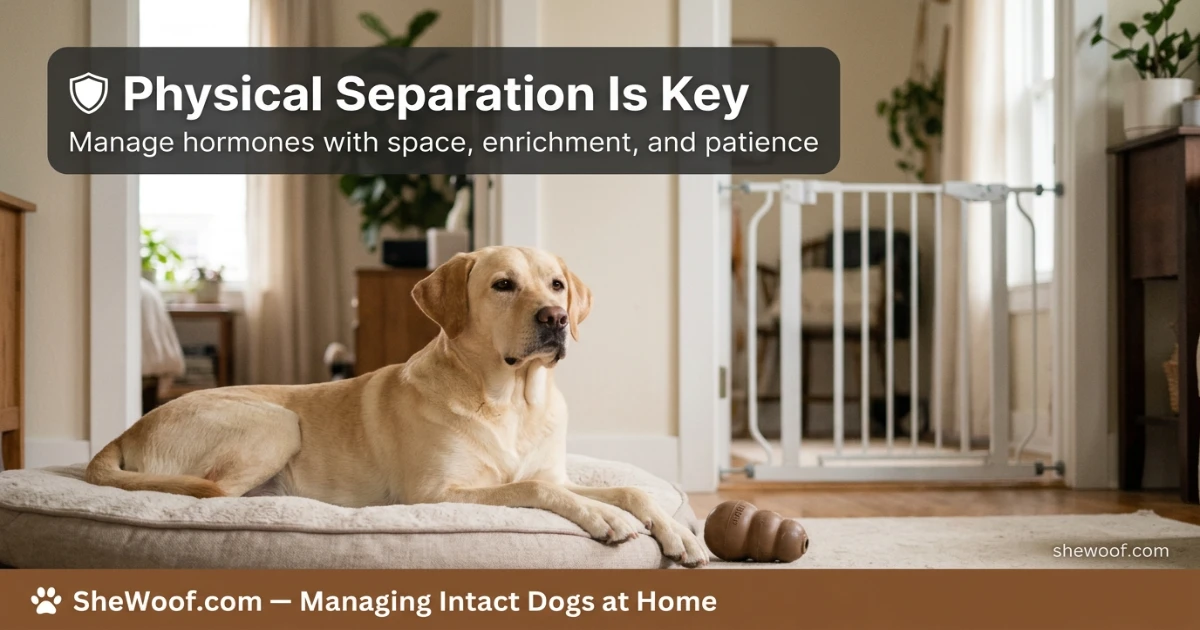
- Separate them completely. Keep the male and female in separate rooms or crates during the female’s heat cycle. Use baby gates, closed doors, and separate walking times. Do not rely on a single barrier — determined males can get through surprising obstacles.
- Walk them at different times and on different routes. Even brief contact outdoors can trigger the hormonal response. Keep walks separate for the duration of the female’s cycle.
- Reduce stress for the male. Provide extra exercise, mental stimulation, and enrichment. A tired, engaged dog is less likely to fixate on the female’s scent.
- Use calming products if helpful. Some owners find that pheromone diffusers or calming supplements help reduce anxiety during this period. Ask your vet before starting any supplement.
- Do not punish the behavior. The drooling is hormonal, not a training problem. Punishing your dog for a physiological response will increase his stress without solving anything.
- Consider neutering. If you are not planning to breed your male dog, neutering can significantly reduce or eliminate the hormonal response to females in heat. Talk to your vet about the best timing for your dog’s age and health.
- Monitor for medical issues. If the drooling continues even after the female’s cycle ends, or if other symptoms appear, see your vet.
What Most Owners Get Wrong About This Behavior
The biggest misunderstanding is that the drooling is a sign of illness. In most cases, it is not. It is a normal physiological response in an intact male who detects a female in heat.
Another common mistake is assuming the male dog is “being bad” or “disobedient.” He is not. He is responding to a biological signal that is stronger than any training cue. Punishing him or expecting him to ignore the scent is unrealistic and unfair.
A third mistake is underestimating the risk of pregnancy. Owners sometimes assume their male is too old, too small, or too well-behaved to mate. In reality, an intact male of any age can and will mate with a female in heat if given the opportunity. Supervision is not enough — physical separation is required.
- Keep a calendar of the female’s heat cycles so you know when to expect the hormonal response.
- Double up on barriers — a closed door plus a crate is better than a closed door alone.
- Give the male extra exercise and mental work during the female’s cycle.
- Wash bedding and floors frequently to reduce lingering pheromones.
- Consider boarding the male during the female’s peak fertile days if home separation is difficult.
- Talk to your vet about neutering if you are not planning to breed.
- If drooling persists after the female’s cycle ends, schedule a vet exam.
When Should You Call a Vet?
Most hormonal drooling resolves on its own once the female’s heat cycle ends. But there are situations where veterinary attention is necessary.
What About Neutering?
Neutering is the most effective long-term solution for hormonally driven drooling. When a male dog is neutered, testosterone levels drop significantly, and the hormonal response to females in heat is reduced or eliminated. Many neutered males show little to no interest in females in heat, while others retain some interest but without the intense physical response.
The timing of neutering is a decision that should be made with your veterinarian. For most dogs, neutering between six and twelve months of age is common, but the ideal timing depends on breed, size, and individual health factors. Some large-breed dogs benefit from waiting until they are closer to full maturity.
If you are not planning to breed your male dog, neutering also eliminates the risk of unwanted litters and reduces the risk of certain cancers and behavioral issues. It is worth discussing with your vet even if the drooling is not severe.
What Realistic Expectations Look Like
If your male dog is intact and lives near a female in heat, you should expect some degree of hormonal response. Drooling, whining, pacing, and reduced appetite are all common and normal. The behavior will resolve once the female’s cycle ends, usually within two to four weeks.
What is unrealistic is expecting your male dog to ignore the scent completely or to respond to training cues as if nothing is happening. The hormonal drive is powerful, and management — not training — is the primary tool.
What is realistic is a plan: separation, extra enrichment, patience, and a conversation with your vet about neutering if the behavior is a recurring problem. With those pieces in place, the drooling becomes a manageable phase rather than a crisis.
- Male dog drooling around a female puppy is usually a hormonal response triggered by her scent, especially if she is in or approaching heat.
- Drooling is not dangerous by itself, but intact males can become determined to reach the female and may stop eating or become destructive.
- A female puppy can become pregnant during her first heat, which can occur as early as four months of age.
- Physical separation is the most reliable management tool during a female’s heat cycle; do not rely on training or supervision alone.
- If drooling is sudden, unexplained, or accompanied by other symptoms, see a vet to rule out dental, gastrointestinal, or neurological causes.
- Neutering is the most effective long-term solution for hormonally driven drooling.
Frequently Asked Questions
Why is my male dog drooling around a female puppy?
Most likely it is a hormonal response triggered by the female’s scent. If she is in or approaching heat, her pheromones signal fertility to intact males, causing drooling, whining, pacing, and loss of appetite. If she is not in heat and drooling is sudden or excessive, a vet check is warranted.
Can a male dog get a female puppy pregnant?
Yes. A female puppy can become pregnant during her first heat, which can occur as early as four to six months of age depending on the breed. If you have an intact male and an intact female puppy, separate them completely during her heat cycle.
Is drooling a sign that my male dog is sick?
Not necessarily. Drooling around a female in heat is normal hormonal behavior. However, drooling that occurs without a female nearby, or that is accompanied by vomiting, difficulty swallowing, or behavior changes, may indicate a medical issue and should be evaluated by a vet.
How long does hormonal drooling last?
Hormonal drooling typically lasts as long as the female is in heat, which is about two to four weeks. The most intense period is usually during the fertile window. Once her cycle ends, the male’s hormonal response usually subsides within a few days.
Will neutering stop my male dog from drooling around females?
Neutering significantly reduces or eliminates the hormonal response in most male dogs. Some neutered males retain mild interest in females in heat, but the intense drooling, pacing, and distress are usually resolved. Discuss timing with your vet.
Can I train my male dog to ignore a female in heat?
Training can help with general impulse control, but it will not override the hormonal drive. Management — physical separation, separate walks, and enrichment — is the primary tool during a female’s heat cycle. Do not punish your dog for a physiological response.
My male dog stopped eating when the female is in heat. Is that normal?
Yes, reduced appetite is a common part of the hormonal response in intact males. It usually resolves once the female’s cycle ends. If your dog refuses food for more than 24 hours or shows other symptoms like vomiting or lethargy, contact your vet.
When should I see a vet about my dog’s drooling?
See a vet if drooling is sudden and unexplained, occurs without a female in heat nearby, or is accompanied by vomiting, diarrhea, difficulty swallowing, pawing at the mouth, head tilt, tremors, or behavior changes. Also see a vet if drooling continues after the female’s cycle has ended.