
How to Train a Yorkie to Be a Service Dog: A Realistic Step-by-Step Guide
Quick Answer: Yes, a Yorkshire Terrier can be trained as a service dog — but only for specific tasks that match their small size. A Yorkie cannot guide a blind person, pull a wheelchair, or provide mobility support. What a well-trained Yorkie can do is serve as a psychiatric service dog, a medical alert dog (for conditions like diabetes, seizures, or anxiety attacks), a hearing dog, or a small task-trained companion who retrieves medication, interrupts harmful behaviors, and provides deep pressure therapy. The path requires an exceptional temperament, early socialization, thousands of hours of training, and honest evaluation of whether your individual Yorkie has the right personality for public access work. Most Yorkies make wonderful emotional support animals — but not all are cut out for the rigors of being a true service dog.
You are considering training your Yorkshire Terrier to be a service dog. Maybe you live with anxiety, diabetes, hearing loss, or another condition that a trained dog could help you manage — and you want the dog who already sleeps beside you to be the one who helps you through the day. You search “how to train a yorkie to be a service dog” because you know it is possible in theory, but you need honest guidance on whether your specific dog — and your specific needs — are a realistic match.
Here is that honest guidance. Yorkies are smart, trainable, and deeply bonded to their owners. They can learn an impressive array of service tasks. But they are also small, fragile, and sometimes stubborn — qualities that matter in public access work. This guide walks you through temperament evaluation, foundational training, task selection, public access preparation, legal realities, and the financial and emotional investment involved. No sugarcoating. No false promises. Just the information you need to make a clear-eyed decision.
Can a Yorkshire Terrier Really Be a Service Dog?
Yes — with significant caveats. The Americans with Disabilities Act (ADA) does not restrict service dogs by breed or size. Any dog, regardless of breed, can be a service dog if they are individually trained to perform tasks that mitigate their handler’s disability. This means a Yorkshire Terrier can legally be a service dog. The question is not whether it is legal. The question is whether it is practical, safe, and effective for both the dog and the handler.
A service dog must be able to work calmly and reliably in public environments — grocery stores, restaurants, airplanes, medical offices, crowded sidewalks. They must ignore distractions, tolerate being handled, remain under control off-leash when necessary, and perform their trained tasks on command even in chaotic conditions. This is a high bar for any dog. It is a particularly high bar for a toy breed whose size makes them vulnerable in crowded spaces and whose terrier nature includes a healthy dose of independence and reactivity.
That said, many Yorkies have successfully served as psychiatric service dogs, diabetic alert dogs, seizure alert dogs, and hearing dogs. The breed’s intelligence, trainability, and intense bond with their owner work in their favor. The small size that makes them unsuitable for mobility work is actually an advantage for tasks like deep pressure therapy — a 5-to-7-pound dog lying on your chest during a panic attack provides calming pressure without being overwhelming. The right Yorkie, trained for the right tasks, can absolutely change a handler’s life.
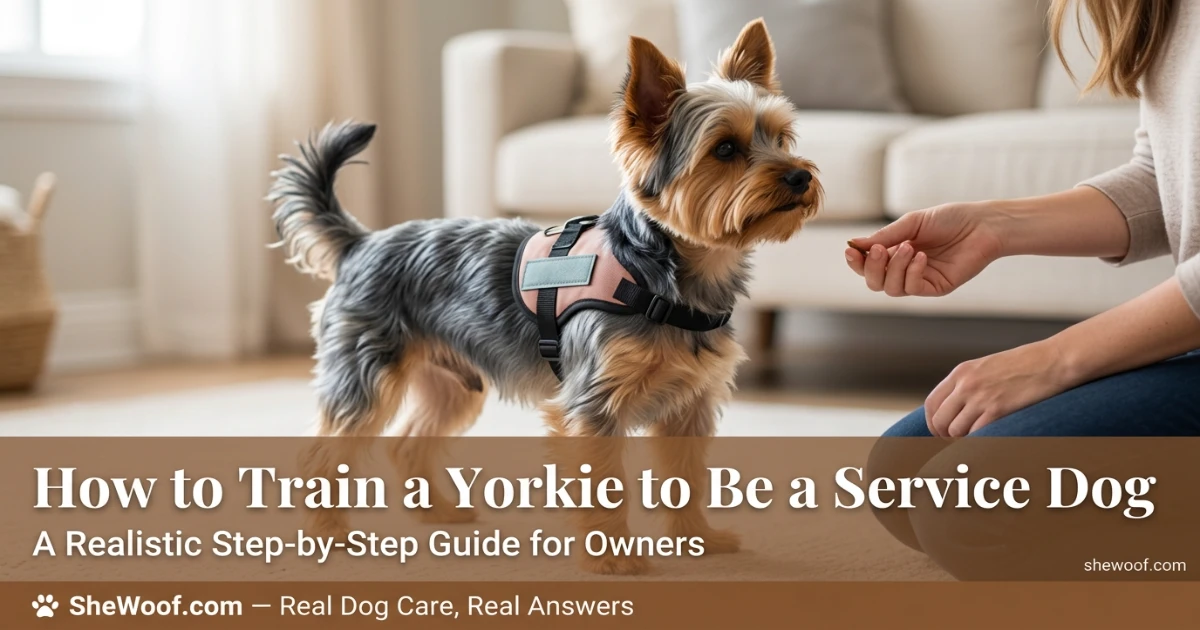
Is Your Yorkie a Good Candidate? Honest Temperament Evaluation
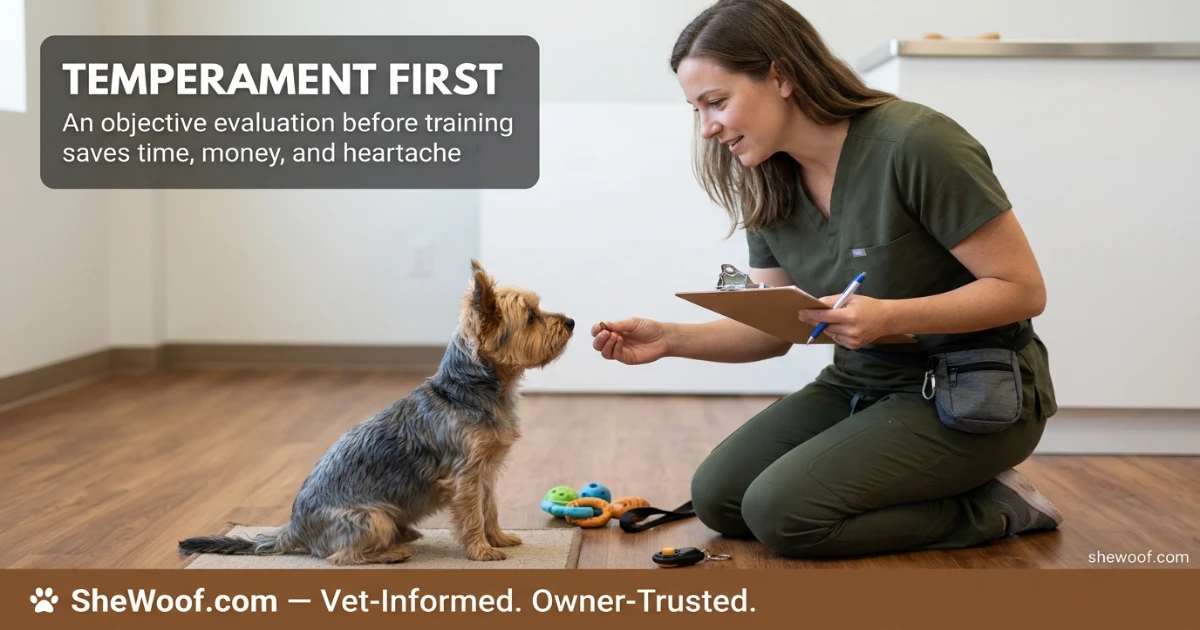
Before spending a single dollar or hour on service dog training, evaluate your Yorkie’s temperament with brutal honesty. Not every Yorkie is suited for public access work — in fact, most are not. The ideal service dog candidate — regardless of breed — is confident but not aggressive, friendly but not overly excitable, attentive to their handler, and able to recover quickly from startles. In dog training terms, they have high “nerve strength.” They do not panic when a shopping cart rattles past or a stranger reaches toward them.
Red flags for service work include: excessive barking at strangers or other dogs, fearfulness in new environments, resource guarding, separation anxiety, aggression of any kind, and an inability to settle in busy places. These behaviors can sometimes be improved with training, but a dog who is fundamentally anxious or reactive will find public access work stressful — and a stressed service dog is not a reliable service dog. It is kinder to both you and your Yorkie to recognize this early and adjust your expectations.
The best way to get an objective temperament assessment is to work with a professional dog trainer or veterinary behaviorist who has experience with service dog evaluations. They will look at your Yorkie through different eyes than you do — seeing not just the dog you love, but the dog who will need to perform under pressure. Their honest assessment can save you years of frustration and thousands of dollars.
Step-by-Step: How to Train a Yorkie to Be a Service Dog
Phase 1 — Foundational Obedience (Months 1–6): Before any task training begins, your Yorkie needs rock-solid basic obedience. Sit, stay, down, come, heel, leave it, drop it, and a reliable focus command. Your dog must respond to these cues the first time, every time — not just when you have a treat in your hand. This phase is about building communication and reliability. Short, daily training sessions work best. Yorkies respond brilliantly to positive reinforcement and will work enthusiastically for the right rewards.
Phase 2 — Socialization and Desensitization (Months 2–12): A service dog must be unflappable in public. This means systematic exposure to every environment your dog will work in — busy sidewalks, grocery stores, restaurants, elevators, stairs, public transit, and medical offices. The goal is not just tolerance but genuine comfort. Your Yorkie should walk calmly beside you, ignore food on the ground, accept being petted by strangers (or not petted — depending on their training), and remain focused on you even when the world is loud and unpredictable. This phase is where most service dog candidates — of any breed — wash out. It is not easy. Go slowly. Reward heavily. Build duration gradually.
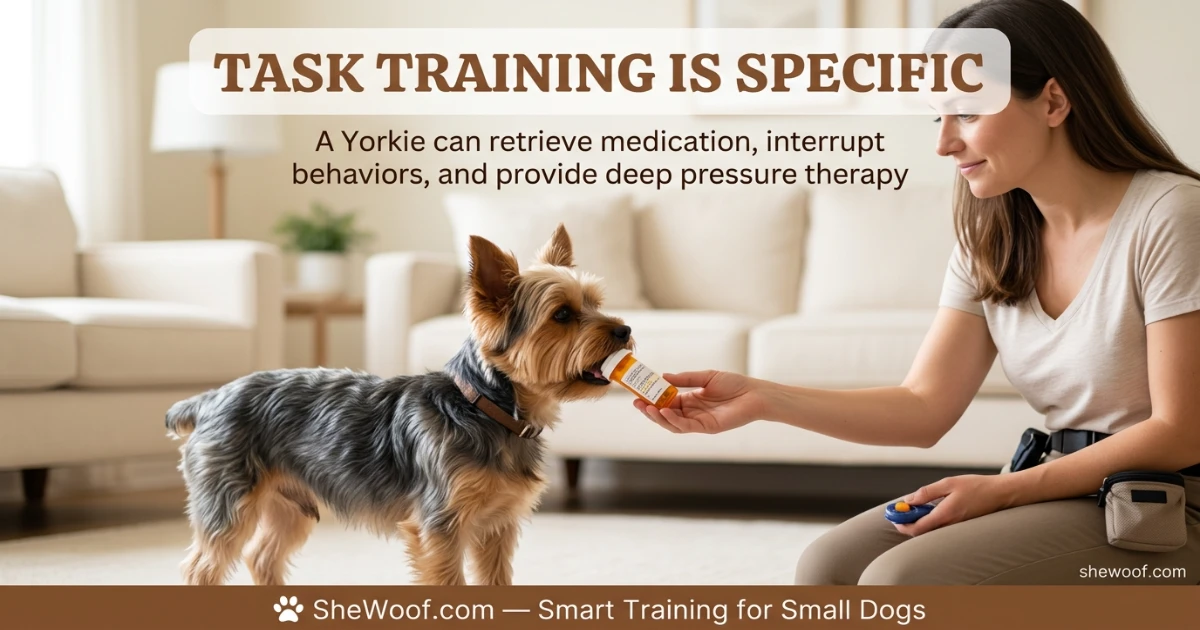
Phase 3 — Task Training (Months 6–18): This is where your Yorkie learns the specific tasks that mitigate your disability. The tasks must be tailored to what you actually need. Examples for a Yorkie-sized service dog include: alerting to a specific sound (doorbell, alarm clock, someone calling your name), retrieving small objects like medication bottles or keys, interrupting a repetitive behavior like scratching or hand-flapping, providing deep pressure therapy during anxiety or panic, and alerting to changes in your body chemistry if trained for medical alert work. Task training is highly individualized — a professional trainer with service dog experience is invaluable here.
Phase 4 — Public Access Proofing (Months 12–24): Once your Yorkie can perform tasks reliably at home, it is time to proof those tasks in public environments. This is the hardest phase. Distractions multiply. The stakes feel higher. Your dog must perform the same tasks in a grocery store aisle, a crowded restaurant, a busy airport terminal. Some dogs excel at home and crumble in public. Others surprise you with their resilience. Continue practicing until your dog is reliable 95% of the time or better in all environments you will actually use them in.
What Most Owners Get Wrong About Training a Yorkie as a Service Dog
The most common mistake is buying a service dog vest online and calling the dog a service dog. A vest is a piece of fabric. It does not confer legal status, it does not magically train the dog, and using it to take an untrained dog into public places is both illegal and harmful — it makes life harder for legitimate service dog teams and puts an unprepared dog in stressful situations. The vest comes last, after the training, not first.
Another frequent error: choosing tasks that do not match the dog’s size. A Yorkie cannot physically perform mobility tasks, guide work, or wheelchair assistance. Trying to force these roles sets the dog up for failure and injury. Match the tasks to the dog. A Yorkie can be a brilliant psychiatric service dog, hearing dog, or medical alert dog. A Yorkie cannot be a guide dog. Accept the limitations and build on the strengths.
A third mistake is rushing the timeline. Service dog training takes 18 months to 2 years or more — and that is for a dog with the right temperament. Some owners expect their Yorkie to be ready in a few months. That is unrealistic. Rushed training produces unreliable dogs. Reliability is the entire point of a service dog. Patience is not optional.

Owner-training a service dog with professional guidance typically costs $5,000 to $15,000 over the training period — including trainer fees, temperament evaluations, equipment, and group classes. Professional board-and-train programs for service dogs range from $20,000 to $30,000 or more. Pre-trained service dogs from reputable organizations can cost $25,000 to $50,000+. Health testing, veterinary care, and ongoing training maintenance add to the total. This is a significant financial commitment. Before investing, have a clear conversation with your medical provider and a service dog trainer to confirm that a service dog — and specifically a Yorkie — is the right support tool for your disability.
Legal Requirements and What a Service Dog Must Do in Public
In the United States, there is no official certification, registry, or ID card for service dogs. Any website selling “official service dog certification” is operating a scam. Under the ADA, a service dog is defined by two things: the handler has a disability, and the dog is individually trained to perform tasks that mitigate that disability. If someone asks whether your dog is a service dog, you may legally be asked two questions: “Is the dog a service animal required because of a disability?” and “What work or task has the dog been trained to perform?” You are not required to show documentation, answer questions about your disability, or demonstrate the task.
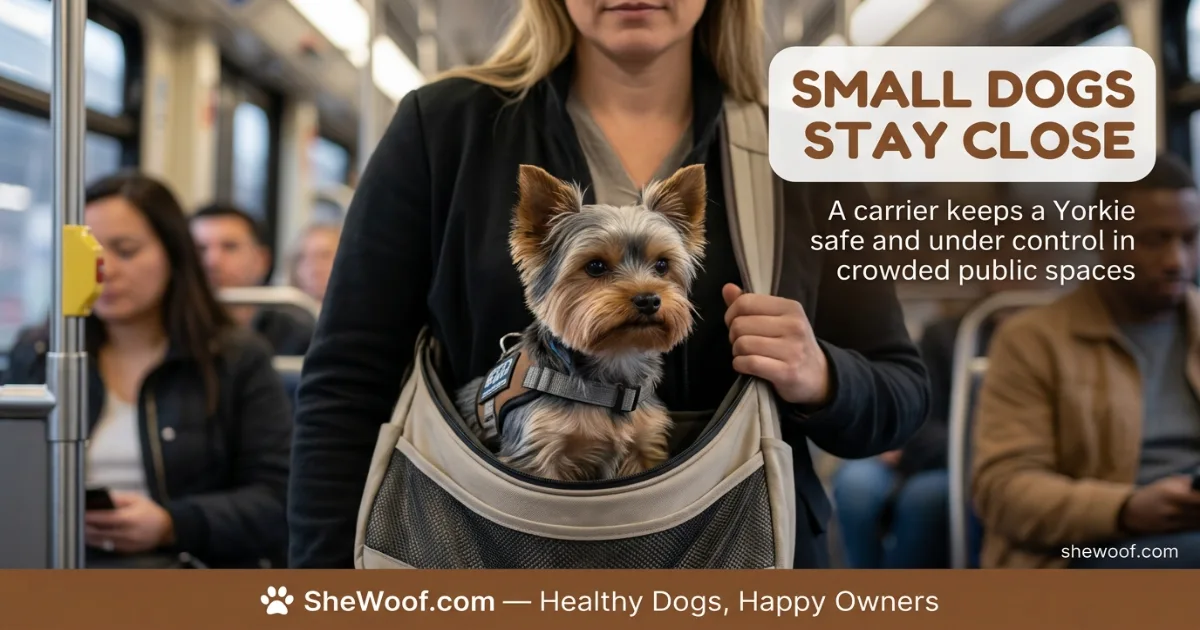
Your service dog must be under control at all times in public. This means they are housebroken, do not bark excessively, do not approach or jump on people, do not eliminate indoors, and do not pose a threat to others. A dog who is disruptive or out of control can legally be asked to leave — even if they are a legitimate service dog. For a Yorkie, this often means riding in a carrier or being carried during crowded situations while remaining focused and task-ready. Small service dogs still need to perform their tasks — being carried does not excuse them from work.
Frequently Asked Questions About Yorkies as Service Dogs
Plan for 18 months to 2 years or more. The timeline includes foundational obedience, extensive socialization, task-specific training, and public access proofing. Rushing the process produces an unreliable dog — and reliability is the entire point of a service dog. Some dogs take longer. Some wash out entirely. The timeline depends on the individual dog’s temperament and the complexity of the tasks.
A Yorkie can perform many tasks that do not require size or strength: psychiatric tasks (deep pressure therapy, interrupting panic attacks, reminding to take medication), hearing dog tasks (alerting to doorbells, alarms, someone calling your name), medical alert tasks (diabetic alert, seizure alert — with appropriate scent training), and retrieving small objects. Yorkies cannot perform guide work, mobility assistance, or wheelchair pulling.
Not for the right tasks. A Yorkie is too small for mobility work or guide work. But for psychiatric, hearing, medical alert, and small-object retrieval tasks, their size is not a barrier — and can actually be an advantage. A small dog fits easily in a carrier on public transit, sits comfortably on a lap during deep pressure therapy, and is less intimidating to the public than a large breed.
Yes — owner-training is legal and common. But it is extremely demanding. Most successful owner-trainers work closely with a professional service dog trainer for guidance, temperament evaluation, task training, and public access proofing. If you have never trained a service dog before, the professional support is not optional. The stakes are high — for you, for your dog, and for the legitimacy of the service dog community.
A service dog is individually trained to perform specific tasks that mitigate a disability and has public access rights under the ADA. An emotional support animal provides comfort through presence but has no public access rights. Many Yorkie owners find that an ESA meets their needs. Be honest about which you need before investing in service dog training.
The right Yorkie can make an excellent small service dog for specific tasks. The breed is intelligent, trainable, and deeply bonded to their owner. The key is temperament — a calm, confident Yorkie can excel. A nervous, reactive, or excessively barky Yorkie will struggle with public access work and may wash out. Professional temperament evaluation is the essential first step.
No. In the United States, there is no official certification, registry, or ID card for service dogs. Any website selling certification is running a scam. A service dog is defined by two things: the handler has a disability, and the dog is trained to perform tasks that mitigate that disability. You do not need paperwork — but your dog must be under control and task-trained.
- A Yorkshire Terrier can be a service dog for specific tasks — psychiatric support, hearing alerts, medical alerts, and small-object retrieval — but not for mobility, guide, or wheelchair work.
- Service dog training takes 18 months to 2+ years and costs $5,000 to $30,000+. It is a serious financial and emotional investment that requires honest evaluation of your dog’s temperament and your actual needs.
- The essential first step is professional temperament evaluation. A calm, confident Yorkie can succeed. An anxious, reactive, or aggressive Yorkie should not be forced into public access work.
- There is no official service dog certification in the USA. A service dog is defined by disability and trained tasks — not by a vest, ID card, or online registry.
- Your service dog must remain under control in public. For a small dog like a Yorkie, this often means using a carrier or sling in crowded areas while staying task-ready.
- Many Yorkie owners are better served by an emotional support animal than a service dog. Be clear-eyed about the legal and practical differences before making a commitment.