
Can You Crack a Dog’s Back? Safety, Risks, and Professional Alternatives
Quick Answer: No, you should not attempt to crack your dog’s back at home. A dog’s spine is not built like a human’s, and the “cracking” sound you hear in human chiropractic does not translate safely to canine anatomy. Applying force to a dog’s spine without proper training can cause severe injury, including fractures, nerve damage, or paralysis. If you believe your dog has back pain, the safe path is a veterinary exam first, followed by a referral to a certified veterinary chiropractor or rehabilitation specialist if appropriate.
You have seen the videos online. Someone presses on a dog’s neck or back, there is a loud crack, and the dog seems to relax. It looks simple. It looks like something you could try at home when your dog seems stiff or sore. But the question of can you crack a dog’s back is not about whether it looks easy. It is about whether it is safe. And for the average dog owner, the answer is a clear no.
I have watched certified veterinary chiropractors work, and I have also seen the aftermath of well-meaning owners who tried to replicate what they saw on social media. The difference between a trained professional and a DIY attempt is not just technique. It is anatomy, diagnosis, and the ability to recognize when manipulation is dangerous rather than helpful. Here is what you need to know before you put your hands on your dog’s spine.

Why Is Cracking a Dog’s Back Different From a Human’s?
The anatomy is fundamentally different. A human spine is vertical, bearing weight from top to bottom. A dog’s spine is horizontal, supported by four limbs and a complex network of muscles and ligaments. The forces that travel through a dog’s spine are not the same as those in a human spine, and the techniques used in human chiropractic do not transfer directly [citation:2][citation:3].
The “cracking” sound itself is also misunderstood. In both humans and dogs, the pop is caused by gas bubbles forming in the joint capsule when the joint surfaces are pulled apart. It is not a bone “realigning” or “going back into place” [citation:3]. The sound is not a measure of success, and its absence does not mean the treatment failed. In fact, veterinary chiropractors note that animal adjustments often do not produce the loud popping sounds heard in human chiropractic, because the structure of animal joints is different [citation:7].
When an untrained person attempts to replicate a high-velocity thrust on a dog, the angle, force, and joint locking are almost always wrong. A canine physiotherapist with chiropractic training described the risk plainly: without proper locking of the joint, the manipulation creates shear forces that increase the risk of injury to the joint capsule, ligaments, or vertebral joints [citation:3]. In severe cases, the wrong technique on a dog’s neck can be fatal [citation:13].
What Happens If You Crack a Dog’s Back Incorrectly?
The risks are not theoretical. Veterinary professionals and animal physiotherapists have documented the potential for serious harm when spinal manipulation is performed without proper training or diagnosis.
Fractures and dislocations: A dog’s vertebrae are smaller and more delicate than a human’s, especially in small breeds. Excessive force or an incorrect angle can fracture a vertebra or damage the growth plates in a young dog [citation:3][citation:15].
Nerve damage and paralysis: The spinal cord runs through the vertebral column. A misplaced thrust can compress or damage the cord, leading to loss of sensation, weakness, or paralysis. Veterinary neurologists have spoken out about the dangers of untrained practitioners applying force to animals’ spines [citation:8].
Worsening of existing conditions: If your dog has an undiagnosed fracture, intervertebral disc disease (IVDD), or cancer in the spine, manipulation can make the condition dramatically worse. Veterinary chiropractic guidelines list cancer, fractures, acute disc disease, and bleeding disorders as contraindications to manipulation [citation:2].
Soft tissue injury: Even without a fracture, the muscles, ligaments, and joint capsules around the spine can be torn or strained by a forceful, poorly directed thrust [citation:3].
What Does a Qualified Veterinary Chiropractor Actually Do?
Veterinary chiropractic — also called veterinary spinal manipulation therapy (VSMT) — is a legitimate manual therapy when performed by a trained professional. But what happens in a professional session looks very different from the social media videos.
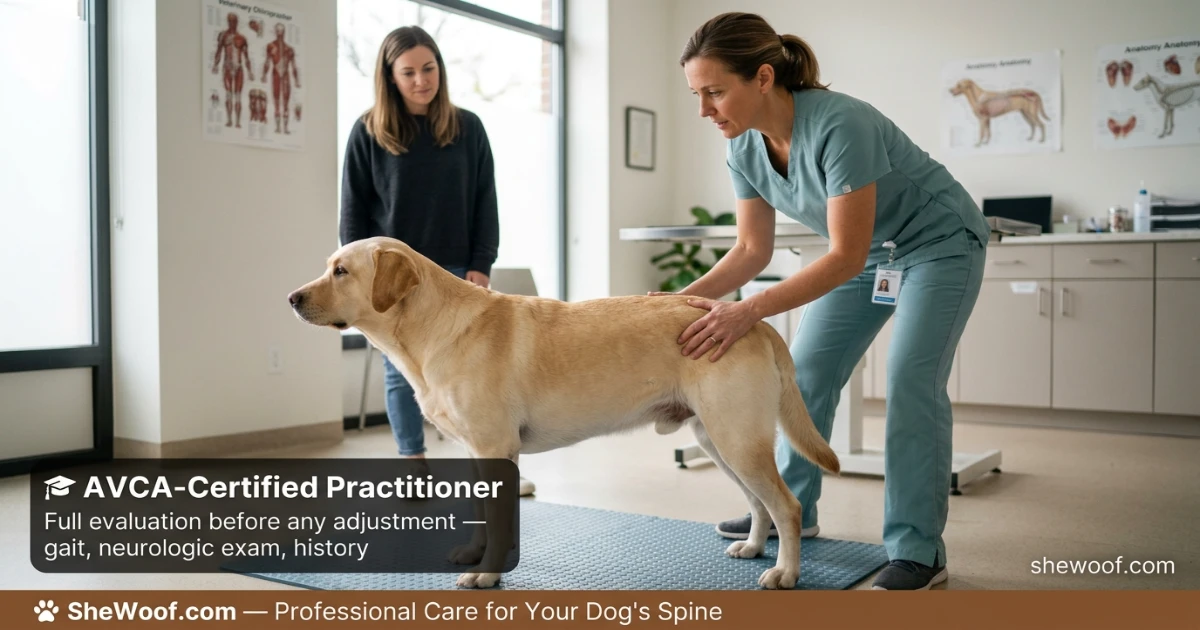
A qualified practitioner begins with a full evaluation. They review your dog’s medical history, observe their gait, perform a complete physical and neurologic examination, and assess the entire body — not just the area that seems sore. They explain their findings before any treatment begins. Depending on the diagnosis, they may recommend additional testing, such as X-rays, before proceeding [citation:2].
The adjustment itself is a controlled, quick, but gentle thrust applied to a specific joint at a precise angle. The force is tailored to the dog’s size, age, and condition. In many cases, the goal is not a loud crack but a restoration of normal range of motion. The practitioner will also discuss home care, follow-up, and what changes you might expect to see [citation:2].
When Is Veterinary Chiropractic Appropriate?
Veterinary chiropractic is most commonly used as part of a broader rehabilitation or pain management plan. It may be considered for conditions with a neurologic or biomechanical origin, including chronic back or neck pain, hip dysplasia, degenerative joint disease, and some cases of intervertebral disc disease — but only after a veterinary diagnosis and with careful case selection [citation:2].
It is not a replacement for conventional veterinary care. If your dog has a fracture, an active infection, cancer, or acute disc disease, chiropractic is not appropriate and may be harmful [citation:2]. This is why the first step is always a veterinary exam, not a chiropractic appointment.
| Situation | Is Chiropractic Appropriate? | What to Do Instead |
|---|---|---|
| Mild stiffness, no pain, normal gait | Maybe — after vet exam | Vet check, then discuss referral |
| Chronic back pain, diagnosed | Yes — as part of a plan | Vet referral to certified practitioner |
| Acute disc disease or paralysis | No | Emergency vet care |
| Suspected fracture or trauma | No | Emergency vet care and imaging |
| Cancer, fever, or active infection | No | Treat the underlying condition first |
What Should You Do If You Think Your Dog Has Back Pain?
- Do not attempt to crack or adjust your dog’s back yourself. The risks of DIY manipulation far outweigh any potential benefit.
- Schedule a veterinary exam. Your vet can assess for pain, neurologic deficits, and underlying conditions that might be causing the symptoms.
- Describe the symptoms clearly. Note when your dog seems stiff, reluctant to move, or sensitive to touch. Mention any changes in gait, appetite, or behavior.
- Ask about a referral. If your vet believes manual therapy is appropriate, they can refer you to a veterinarian or chiropractor certified by the American Veterinary Chiropractic Association (AVCA) [citation:2].
- Continue supportive care at home. Keep your dog at a healthy weight, provide soft bedding, use ramps or steps to reduce jumping, and follow your vet’s recommendations for exercise and rest.
What About the “Bone Breaker” Videos Online?
The viral videos showing dramatic cracks and seemingly instant results are not a reliable guide to safe care. Animal physiotherapists and veterinarians have publicly criticized these videos for showing animals in distress, using excessive force, and ignoring the need for diagnosis and follow-up care [citation:3][citation:18]. The短暂的 relaxation some animals show after a forceful adjustment is not evidence of a cure. It may be a stress response or a temporary numbing of pain that does not address the underlying problem [citation:3].
Chiropractic care, when done well, is one tool among many. It is not a standalone fix, and it is not something to try at home based on a video. The dogs who benefit most are those whose owners work with their veterinarian, get a proper diagnosis, and follow a comprehensive plan that may include weight management, exercise modification, physical therapy, and other supportive care.
A session with a certified veterinary chiropractor typically costs $75 to $200, depending on your location and the practitioner’s credentials. The initial visit is often longer and more expensive because it includes a full evaluation. Follow-up sessions are usually shorter. This is a financial commitment, but it is far less than the cost of treating a spinal injury caused by an unsafe DIY attempt.
Frequently Asked Questions About Cracking a Dog’s Back
No, you should not attempt to crack your dog’s back at home. A dog’s spine is anatomically different from a human’s, and applying force without proper training can cause fractures, nerve damage, or paralysis. If your dog has back pain, see a veterinarian first. A certified veterinary chiropractor may be appropriate after a proper diagnosis.
No. DIY spinal manipulation on a dog is dangerous. Even trained human chiropractors need additional certification to work on animals because the anatomy and techniques are different. Untrained manipulation can cause serious injury.
Incorrect manipulation can fracture vertebrae, damage the spinal cord, tear ligaments, or worsen an existing condition like intervertebral disc disease. In severe cases, it can cause paralysis or death. The risk is not worth it.
When performed by a qualified, certified practitioner after a veterinary diagnosis, veterinary chiropractic is generally considered safe. However, it is not appropriate for every condition. Cancer, fractures, and acute disc disease are contraindications. Your veterinarian should be involved in the decision.
See your veterinarian first. They can diagnose the cause of the pain and recommend appropriate treatment. Do not attempt to adjust your dog’s spine at home. If manual therapy is appropriate, your vet can refer you to a certified veterinary chiropractor.
The temporary relaxation some dogs show may be due to a neuromodulation effect — a temporary override of pain signals — or a stress response. It is not evidence that the underlying problem has been fixed. Lasting improvement usually requires a comprehensive plan, not a single adjustment.
No. Human chiropractors are not trained in canine anatomy unless they have additional AVCA certification. In many places, it is illegal for a human chiropractor to treat animals without veterinary supervision. Always choose a practitioner with specific training in animal chiropractic.
- Do not attempt to crack your dog’s back at home. The anatomy is different from a human’s, and the risks include fractures, nerve damage, and paralysis.
- The “cracking” sound is not a sign of success. It is a gas bubble in the joint, and its absence does not mean the treatment failed.
- See a veterinarian first for any sign of back pain. A proper diagnosis is essential before any manual therapy is considered.
- If veterinary chiropractic is appropriate, choose a practitioner certified by the American Veterinary Chiropractic Association (AVCA).
- Veterinary chiropractic is not a replacement for conventional care. It is one tool that may be part of a broader plan.