
How to Make a Dog Like a Cat: A Patient, Proven Introduction Guide
Quick Answer: Making a dog like a cat — or at least coexist peacefully — requires gradual, controlled introductions over days or weeks, never a forced face-to-face meeting. Start by keeping the cat and dog separated by a closed door, allowing them to smell and hear each other without visual contact. Feed them on opposite sides of the door so they associate each other’s scent with something positive. Progress to supervised visual contact through a baby gate or cracked door, then short, leashed in-person meetings where the cat always has an escape route. Reward calm behavior from both animals. The goal is tolerance and peaceful coexistence — not forced friendship.
You brought a cat into a home with a dog. Or you brought a dog into a home with a cat. Either way, the first face-to-face meeting did not go the way those heartwarming viral videos promised. The dog barked. The cat hissed and vanished under the couch. Now you are searching “how to make dog like cat” because you need a real plan — not a fantasy — for creating a peaceful home where both animals feel safe. You are not alone. Thousands of multi-pet households start exactly here: with a closed door, a tense atmosphere, and the hope that things can get better.
They can. But “better” does not always mean best friends who cuddle and groom each other. For many dog-cat pairs, success looks like calm coexistence: the dog ignores the cat, the cat walks through the room without fear, and both animals live without chronic stress. That is a genuine win. With the right introduction protocol, the right management tools, and realistic expectations, most dogs and cats can reach that baseline — and many go further.
Why Forcing a Dog and Cat Together Backfires
The most common mistake owners make is rushing the introduction. They hold the cat in their arms and bring it near the dog. Or they put both animals in the same room and hope they “work it out.” This almost always backfires. The dog — especially a breed with prey drive — becomes over-aroused by the moving, fast, small creature. The cat experiences terror and encodes a permanent fear memory associated with the dog. Even if no one is physically injured in that first rushed meeting, the emotional damage can take months or years to undo.
Cats are not small dogs. Their body language, communication signals, and stress responses are fundamentally different. A dog who means no harm can still be terrifying to a cat simply by approaching too quickly, staring too intently, or sniffing too invasively. A cat who hisses and swats is not being mean — they are communicating fear in the only language they have. Forcing proximity teaches the dog that the cat is a source of excitement and teaches the cat that the dog is a predator. Neither lesson leads to a peaceful home.
The introduction protocol that works is slow, scent-first, and designed around the cat’s need for safety and the dog’s need for impulse control. It respects the biology of both species. It prioritizes preventing bad experiences over creating good ones — because one terrifying encounter can undo weeks of careful work. Patience is not a virtue in this process. It is the entire process.

Step-by-Step: How to Make a Dog Like a Cat
Phase 1 — Scent Swapping Only (Days 1–3): The cat stays in a separate room with a closed door. The dog stays in the rest of the home. They cannot see each other. They can only hear and smell each other through the gap under the door. Rub a soft cloth on the cat’s cheeks and flanks — where scent glands are concentrated — and place that cloth near the dog’s bed. Do the reverse: rub a cloth on the dog and place it in the cat’s room. Feed both animals on opposite sides of the closed door so they associate each other’s scent with meals. After a day or two, swap bedding. The goal is scent familiarity before visual exposure.
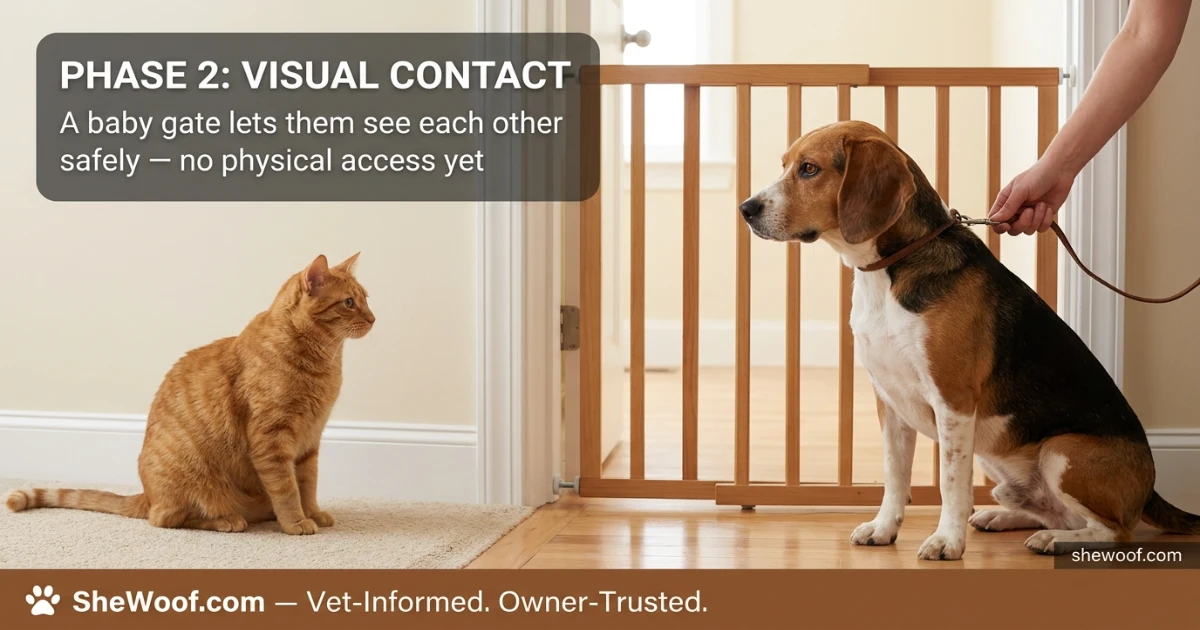
Phase 2 — Visual Contact Through a Barrier (Days 3–7): Use a baby gate, a pet gate, or a door propped open just a few inches so the animals can see each other but not make physical contact. Keep the dog on a leash for safety, even with the barrier in place. Keep sessions short — 5 to 10 minutes — and end them while both animals are still calm. Reward the dog for looking at the cat and then looking back at you. This is the foundation of impulse control: see the cat, disengage, get a reward. If the cat hides, do not force them out. Let the cat set their own pace for visibility.
Phase 3 — Leashed In-Room Meetings (Days 7–14+): When both animals are consistently calm during Phase 2, move to short in-person meetings with the dog on a leash and the cat free to move around the room. The cat must always have escape routes — high perches, cat trees, shelves, or an open door to a safe room. Do not let the dog chase. Do not let the dog corner the cat. Reward calm behavior, disengagement, and any moment where the dog chooses to look away from the cat. Sessions remain short. End on a positive note. Increase duration gradually over many days.
How Breed and Prey Drive Affect the Process
Not all dogs approach a cat with the same intent. Breeds with high prey drive — terriers, hounds, huskies, and many herding breeds — are genetically programmed to notice, chase, and sometimes capture small moving animals. This does not mean these dogs cannot live with cats. It means the introduction must be more careful, the management more rigorous, and the expectations more realistic. A Jack Russell Terrier may never be safe alone with a cat, even if they coexist peacefully under supervision. A Golden Retriever may be genuinely gentle from the start. Both scenarios are normal. Both require honesty about what your individual dog is capable of.
Breed is not destiny — but it is information. A dog with strong predatory motor patterns (staring, stalking, freezing, lunging) needs a higher level of management than a dog who shows casual curiosity and moves on. If you own a breed or mix with known prey drive, invest in solid barriers, practice recall and “leave it” obsessively, and never leave the dog and cat unsupervised until you have months of evidence that the dog reliably ignores the cat. Some dogs earn that trust. Some do not. That does not make them bad dogs. It makes them dogs who need a different management plan.
| Dog Breed / Type | Typical Prey Drive | Introduction Difficulty | Long-Term Management |
|---|---|---|---|
| Retrievers (Golden, Labrador) | Low-Moderate | Easier — often cat-friendly | Supervision until trust is proven |
| Terriers (Jack Russell, Yorkie) | High | Difficult — strong chase instinct | May never be safe unsupervised |
| Herding breeds (Collie, Aussie) | Moderate-High | Moderate — may stalk or herd | Redirect herding behavior; supervise |
| Hounds (Beagle, Greyhound) | High (sight/scent) | Difficult — chase small animals | Barriers; never off-leash around cat |
| Companion breeds (Cavalier, Shih Tzu) | Low | Easier — bred for companionship | Standard introduction protocol |
Reading Dog and Cat Body Language During Introductions
Success depends on reading the subtle signals both animals are sending — and responding before stress escalates into conflict. A relaxed dog shows a soft, wagging tail at body height or lower, loose ears, a relaxed open mouth, and the ability to look at the cat and then look away. A stressed or predatory dog shows a stiff, high tail, hard staring with a fixed gaze, frozen body posture, whale eye (showing the whites of the eyes), and an inability to disengage even when called.
A relaxed cat moves freely through the room, eats, drinks, and uses the litter box normally. Their tail is upright with a slight curl at the tip — the classic friendly cat greeting. Their ears are forward. A stressed cat hides constantly, flattens their ears, hisses, growls, swats, or shows a puffed tail and arched back. A cat who stops eating or using the litter box is communicating severe stress. These are not behaviors to punish or ignore. They are data. If the cat is showing these signs, the introduction is moving too fast. Slow down. Go back a phase. Let the cat’s comfort level — not the human timeline — drive the pace.

What Most Owners Get Wrong About Dog-Cat Introductions
The most dangerous mistake is assuming that because a dog is friendly with humans, they will be friendly with a cat. Human-social behavior and cat-social behavior are not the same thing. A dog who loves children, greets strangers with a wagging tail, and has never shown aggression to anyone can still have intense prey drive toward a cat. The behaviors come from different parts of the canine brain. Do not assume. Observe. Test under controlled conditions. Let the dog’s actual behavior — not their general reputation — guide your decisions.
Another frequent error: using punishment to stop chasing or fixation. Yelling at the dog, jerking the leash, or using shock collars when the dog stares at the cat does not teach the dog to like the cat. It teaches the dog that bad things happen when the cat is present. The dog may suppress the behavior when you are watching, but the underlying arousal remains — and can explode when you are not there. Reward-based training that reinforces disengagement and calm behavior is the only approach that changes the dog’s emotional response to the cat over time.
A third mistake involves the cat’s agency. Forcing a cat to stay in the room, holding them near the dog, or blocking their escape teaches the cat that they are trapped with a predator. This is how cats develop chronic anxiety, stop using the litter box, or begin spraying. The cat must always have the power to leave. When a cat chooses to approach the dog on their own terms, that is progress. When a cat is forced to endure proximity, that is trauma.

Puppies, Adult Dogs, and Senior Dogs: How Age Changes the Approach
Introducing a puppy to a cat is often — but not always — easier than introducing an adult dog. Puppies are learning what the world is, and a well-socialized puppy can learn that cats are part of the household rather than prey. However, puppies are also impulsive, unpredictable, and lack bite inhibition. A puppy who wants to play with the cat can injure or terrify the cat even without aggressive intent. Supervise all puppy-cat interactions closely. Reward gentle behavior. Interrupt rough play immediately. The goal is for the puppy to learn that calm behavior around the cat earns rewards and rough behavior ends the fun.
Adult dogs with unknown histories around cats need the full, slow introduction protocol. You do not know what this dog has experienced — whether they lived peacefully with cats before, chased outdoor cats, or have never seen one. Assume nothing. Start from Phase 1 and let the dog’s behavior tell you how quickly to progress. An adult dog who shows intense prey drive during the scent phase may not be a safe candidate for a multi-cat household at all — and acknowledging that early spares everyone, including the cat, from preventable harm.
Senior dogs can be wonderful companions for cats because they are often calmer and less impulsive. The introduction may progress faster simply because the dog is less interested. However, senior dogs may also have pain, vision loss, or hearing loss that makes them startle more easily. A cat who unexpectedly jumps near a sleeping senior dog could trigger a reflexive snap. Manage the environment so both animals have their own safe spaces.

Frequently Asked Questions About Dogs and Cats Living Together
Go even slower. The cat sets the pace. Keep the cat in a safe room with all resources until they show curiosity rather than fear at the door. Use scent swapping for at least a week before visual contact. Never force the cat out. Reward the dog for calm behavior when the cat is nearby. The cat’s confidence grows when they learn the dog does not pursue them. This can take weeks or months — and that timeline is normal.
For calm, low-prey-drive dogs, peaceful coexistence may develop within 2 to 4 weeks. For dogs with moderate prey drive or excitability, expect 4 to 8 weeks of gradual work before both animals are relaxed together. Some pairs take months to reach true comfort. A small number of dogs — particularly those with strong predatory instincts — may never be safe alone with a cat. The timeline depends on the individual animals, not a universal schedule.
Most dogs can learn to coexist peacefully with cats under supervision and with proper management. However, dogs with intense, unmoving prey drive — especially those who have previously injured or killed small animals — may not be safe candidates for a multi-cat household. Honesty about your dog’s history and instincts is essential for the cat’s safety. A certified professional dog trainer or veterinary behaviorist can help assess your specific situation.
Separate them immediately and calmly. Do not yell or punish — this increases arousal and can make the behavior worse. Return to an earlier phase of the introduction protocol. Increase management: more barriers, a shorter leash, higher perches for the cat. Work on impulse control exercises like “leave it” and “watch me” separately from cat exposure. If chasing persists despite training, consult a professional.
An adult dog with a known, proven history of living peacefully with cats is often the safest choice. Puppies are a blank slate, which can be an advantage — but they are also impulsive, unpredictable, and require months of training before they develop reliable impulse control. If you choose a puppy, commit to the full introduction protocol and close supervision throughout puppyhood. If you choose an adult dog, prioritize a documented cat-friendly history over breed assumptions.
A dog who likes the cat will seek gentle, voluntary proximity — sniffing without pursuit, resting nearby without staring, and responding to the cat’s signals by backing off. A dog who tolerates the cat will ignore them most of the time and may show mild stress signals when the cat is close. Both outcomes are successes. The goal is peaceful coexistence, not forced friendship. Do not expect grooming, cuddling, or play between species — appreciate those as bonuses if they happen.
- Making a dog comfortable with a cat requires a slow, scent-first introduction over days or weeks — never a rushed face-to-face meeting. The cat’s sense of safety must drive the pace of every phase.
- Use three progressive phases: scent swapping through a closed door, visual contact through a barrier, and finally short, leashed in-person meetings where the cat always has escape routes.
- Reward calm behavior and disengagement consistently. The goal is for the dog to learn that ignoring the cat — looking away, staying relaxed — is more rewarding than chasing or fixating.
- Breed and individual prey drive matter. Some dogs may never be safe alone with a cat. Honesty about your dog’s instincts protects the cat from preventable harm.
- Provide vertical space, multiple safe zones, and separate feeding areas so the cat never feels trapped. A cat with agency and escape options is a cat who can learn to coexist without chronic stress.
- Seek professional help from a certified dog trainer or veterinary behaviorist if your dog shows intense, unmoving fixation, lunging at barriers, or an inability to disengage from the cat.