Kennel Cough Coughing Up White Foam? Causes, Treatment & When to Worry
Quick Answer: Dogs with kennel cough often cough up white foam because the forceful, repetitive coughing irritates the throat and airways, producing excess mucus that gets whipped into a frothy consistency. This white foam is respiratory mucus — not stomach vomit. It is one of the hallmark signs of kennel cough, along with a dry, honking cough that sounds like something is stuck in the dog’s throat. Most cases of kennel cough resolve within 1 to 3 weeks with supportive home care. However, if your dog becomes lethargic, refuses food or water, has difficulty breathing, or the white foam contains blood, see a veterinarian promptly — pneumonia is a possible complication.
Your dog has been making a horrible honking noise for two days. This morning, they coughed so hard that a small puddle of white, frothy foam landed on the floor. You search “kennel cough coughing up white foam” because the foam looks alarming — like something you would see in a medical emergency — but your dog is still eating, still wagging their tail, and still following you from room to room. Is this normal for kennel cough? Or is it a sign that the infection is getting worse?
The white foam that comes with kennel cough is, in most cases, a normal — if unsettling — part of the illness. It is not stomach vomit. It is respiratory mucus, churned into foam by the force of repetitive, hacking coughs. Understanding why it happens, what it looks like, and how to distinguish it from more serious conditions gives you the confidence to care for your dog at home — and the knowledge to recognize when it is time to call the vet.
Why Does Kennel Cough Cause White Foam?
Kennel cough — formally called canine infectious respiratory disease complex or CIRDC — is an infection of the upper respiratory tract caused by a combination of viruses and bacteria, most commonly Bordetella bronchiseptica, canine parainfluenza virus, and canine adenovirus type 2. These pathogens inflame the trachea, larynx, and bronchi. The inflammation triggers a dry, hacking, persistent cough that is the hallmark of the disease.
When a dog coughs forcefully and repeatedly, the mechanical action irritates the throat and stimulates mucus production. That mucus — combined with saliva and swallowed air — gets whipped into a white, frothy consistency by the force of the cough. The dog may gag or retch at the end of a coughing fit and bring up a small amount of this foam. It is not vomit. It did not come from the stomach. It came from the respiratory tract, and the coughing fit pushed it into the mouth where it was then expelled.
This is why dogs with kennel cough often seem completely normal between coughing episodes. They eat. They drink. They wag. They play. The foam appears only when a coughing fit is intense enough to bring up respiratory secretions. The foam is a byproduct of the cough — not a sign that the stomach or digestive system is involved.

What Does Kennel Cough Sound and Look Like?
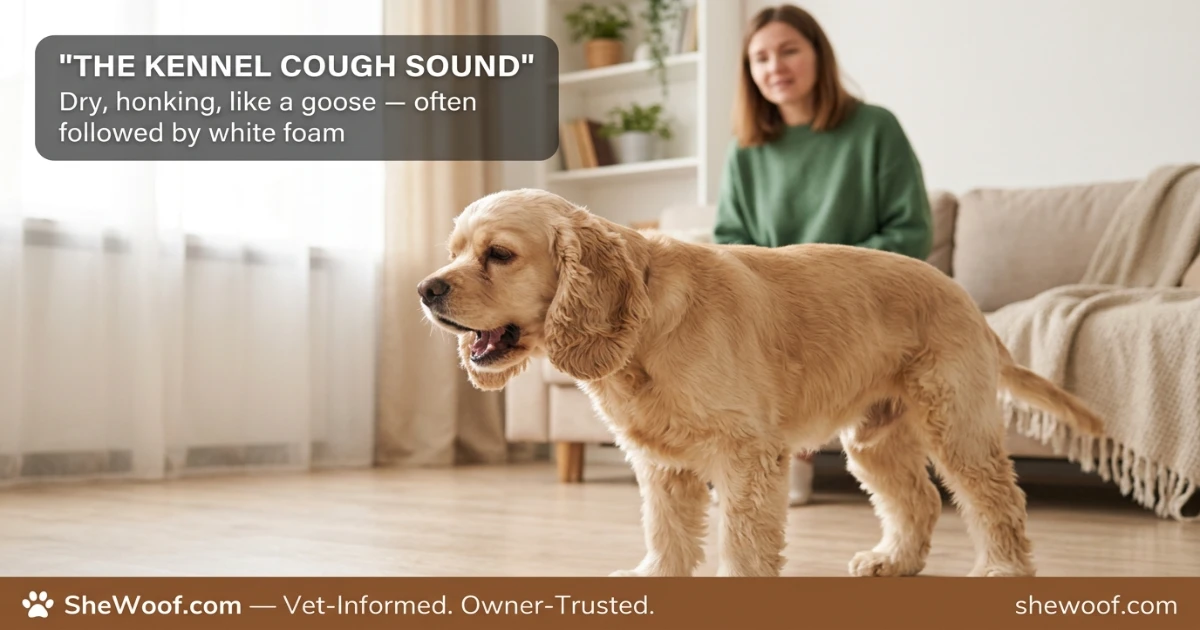
The sound of kennel cough is distinctive. It is often described as a dry, hacking, honking noise — like a goose honk or something stuck in the dog’s throat. Many owners initially worry their dog is choking. The cough is non-productive — meaning nothing comes up with most coughs — and may be triggered by excitement, exercise, or pressure on the throat from a collar. At the end of a particularly intense coughing fit, the dog may gag, retch, and bring up a small amount of white, frothy mucus or foam.
The cough is typically worse at night and in the early morning. It may sound wetter as the illness progresses and more mucus is produced. Some dogs also develop a mild fever, nasal discharge, eye discharge, or sneezing. These additional signs help distinguish kennel cough from other causes of coughing, like collapsing trachea, heart disease, or a foreign body in the throat.
A video recording of the coughing episode — including the sound — is one of the most helpful things you can bring to a veterinary appointment. Kennel cough has a characteristic sound that experienced veterinarians can often identify immediately. If you are unsure whether your dog’s cough matches the description, record it and let your vet listen.
What Most Owners Get Wrong About Kennel Cough and White Foam
The most common mistake is assuming the white foam means the dog is vomiting and needs anti-nausea medication or a diet change. Treating kennel cough foam as a stomach issue misses the actual problem — the respiratory infection — and delays appropriate care. The foam is produced by the cough, not by the stomach. Anti-nausea medications will not stop it. Addressing the cough will.
Another frequent error: restricting water because the dog coughs after drinking. Dogs with kennel cough have irritated throats. Drinking can trigger a cough, and the cough may bring up water mixed with foam. Some owners interpret this as the dog being unable to keep water down and withhold fluids. Do not do this. Hydration is critical for recovery. The water is not being vomited — it is being coughed back up because the throat is sensitive. Offering smaller amounts of water more frequently, using a raised bowl, or adding a little low-sodium broth to encourage drinking all help.
A third mistake involves exercise. Dogs with kennel cough need rest, not their usual walks and playtime. Exercise and excitement trigger coughing fits, which irritate the airways further and prolong recovery. Short, calm leash walks for bathroom breaks are fine. Running, playing, and long walks are not — even if your dog seems energetic and wants to go. Rest the respiratory tract. It heals faster when it is not being stressed.

How Age, Breed, and Health Status Change the Risk
Puppies, senior dogs, and dogs with compromised immune systems are at higher risk for developing kennel cough — and for experiencing more severe symptoms, including pneumonia. Puppies under 6 months have immature immune systems. Senior dogs may have decreased respiratory reserve and coexisting health conditions. Brachycephalic breeds — Pugs, French Bulldogs, English Bulldogs, Boston Terriers — have anatomically narrowed airways that make respiratory infections more difficult to clear and more likely to become serious.
Dogs with collapsing trachea — common in small breeds like Yorkies, Pomeranians, and Chihuahuas — may have a chronic cough that is exacerbated by kennel cough. The combination of an existing tracheal condition and a new respiratory infection can produce severe coughing and significant distress. These dogs should see a veterinarian early in the course of symptoms rather than waiting to see if home care is sufficient.
Vaccinated dogs can still get kennel cough. The Bordetella vaccine — like the human flu vaccine — reduces the likelihood and severity of infection but does not provide complete immunity. A vaccinated dog who develops kennel cough typically has milder symptoms, a shorter illness duration, and a lower risk of complications. The vaccine is worth it — but it is not a force field.
| Symptom / Sign | Typical Kennel Cough | Concerning — Possible Pneumonia |
|---|---|---|
| Cough sound | Dry, honking, hacking | Wet, productive, gurgling |
| Foam / discharge | White, frothy; small amount | Yellow, green, thick; larger volume |
| Energy level | Normal or mildly reduced | Significantly lethargic; hard to rouse |
| Appetite | Normal — may cough after drinking | Refusing food and water |
| Breathing | Normal between coughing fits | Labored, rapid, shallow; belly heaving |
| Temperature | Normal to mildly elevated | Fever — above 103°F |
Treatment: What Works, What Does Not, and What Needs a Vet
Mild, uncomplicated kennel cough in an otherwise healthy adult dog typically resolves with supportive home care over 1 to 3 weeks. Antibiotics are not routinely prescribed because most cases are viral — and antibiotics treat bacteria, not viruses. Your veterinarian will prescribe antibiotics if they suspect a secondary bacterial infection, if the dog has a fever, if nasal discharge turns thick and colored, or if the dog is at high risk for pneumonia.
Cough suppressants are a gray area. Suppressing the cough can provide relief — especially at night when coughing interrupts sleep and delays healing. But coughing is also the body’s mechanism for clearing mucus and pathogens from the airways. Suppressing the cough too much can allow secretions to accumulate in the lungs. Never give over-the-counter human cough medicine to a dog without explicit veterinary instruction — many contain ingredients toxic to dogs, including acetaminophen, pseudoephedrine, and xylitol. Your veterinarian can prescribe a dog-safe cough suppressant at the appropriate dose if they determine it is needed.
Honey — a teaspoon for medium to large dogs, half a teaspoon for small dogs — can soothe an irritated throat. It has mild antimicrobial properties and provides temporary relief. Use plain, raw honey if available. Never give honey to puppies under 1 year due to the risk of botulism spores. Honey is a comfort measure — not a cure — but it genuinely helps reduce coughing frequency in many dogs when used alongside rest and humidity.
Preventing Kennel Cough and Reducing Severity
The Bordetella vaccine — available in oral, intranasal, and injectable forms — is the primary preventive tool. It is required by most boarding facilities, daycares, and groomers. The intranasal form provides local immunity in the nasal passages where the infection typically enters, and it takes effect faster than the injectable form. Discuss with your veterinarian which version is right for your dog. The vaccine is not perfect — but it meaningfully reduces both the likelihood and severity of infection.
Beyond vaccination, avoid high-risk environments during outbreaks. If you hear that kennel cough is circulating in your local dog community — at a particular daycare, dog park, or boarding facility — keep your dog home for a few weeks. The infection spreads through respiratory droplets, shared water bowls, and nose-to-nose contact. It is highly contagious. A dog with kennel cough should be isolated from other dogs for at least 2 weeks after the last cough — even if they seem better. They can still shed the pathogens and infect others.

Frequently Asked Questions About Kennel Cough and White Foam
The white foam is respiratory mucus — not stomach vomit. The forceful, repetitive coughing of kennel cough irritates the throat and stimulates mucus production. That mucus, combined with saliva and air, gets churned into white foam and expelled at the end of a coughing fit. It is a normal — if unpleasant — symptom of kennel cough.
Kennel cough foam is preceded by a dry, honking cough — you will hear the cough first, then see the foam. Vomiting is preceded by abdominal heaving — the dog’s belly contracts before anything comes up. If your dog makes a goose-honk sound and then spits up foam, that is kennel cough. If your dog retches with belly contractions, that is vomiting.
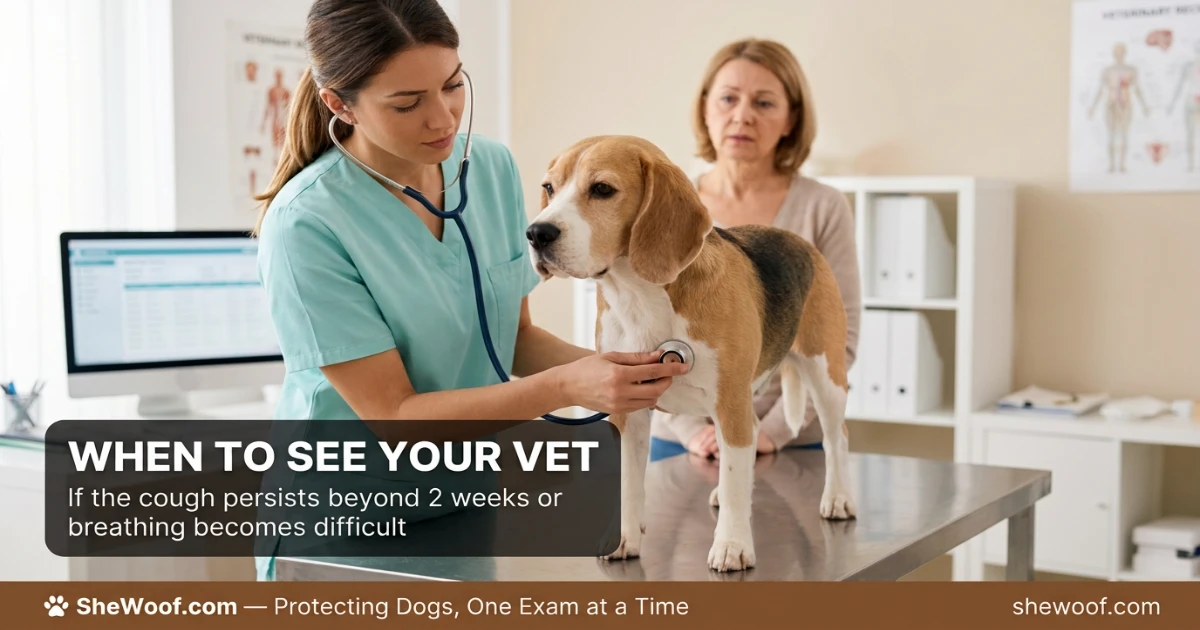
Most dogs recover from kennel cough within 1 to 3 weeks. The coughing — and the white foam that comes with it — typically peaks in the first 5 to 7 days and then gradually decreases. If symptoms persist beyond 3 weeks, worsen after the first week, or new symptoms develop, see your veterinarian to rule out pneumonia or another underlying condition.
A teaspoon of plain honey for adult dogs can soothe the throat and reduce coughing frequency. Use a cool-mist humidifier and steam therapy. Never give over-the-counter human cough medicine — many contain ingredients toxic to dogs. Your veterinarian can prescribe a dog-safe cough suppressant if needed. Antibiotics are only appropriate if a secondary bacterial infection is present.
Worry if the foam changes from white to yellow, green, or bloody; if your dog becomes lethargic, refuses food or water, has labored breathing, runs a fever, or if the cough persists beyond 2 to 3 weeks without improvement. These signs may indicate pneumonia — a serious complication that requires veterinary treatment.
Yes. The Bordetella vaccine reduces the likelihood and severity of kennel cough but does not provide complete immunity — similar to the human flu vaccine. Vaccinated dogs who develop kennel cough typically have milder symptoms, a shorter illness, and a lower risk of complications than unvaccinated dogs.
Yes — highly. Kennel cough spreads through respiratory droplets, shared water bowls, and nose-to-nose contact. A coughing dog can infect other dogs from several feet away. Keep your dog isolated from other dogs for at least 2 weeks after the last cough — even if they seem better. They remain contagious even after symptoms resolve.
- Kennel cough often produces white foam because forceful coughing churns respiratory mucus, saliva, and air into a frothy consistency — this is airway mucus, not stomach vomit.
- The classic kennel cough sound is a dry, honking, goose-like noise, often followed by gagging and a small amount of white foam. Most dogs remain bright, alert, and eating between coughing episodes.
- Mild, uncomplicated kennel cough typically resolves with home care in 1 to 3 weeks: rest, a harness instead of a collar, humidity, steam therapy, and a teaspoon of honey for adult dogs.
- Antibiotics are not routinely needed — kennel cough is usually viral. They are prescribed only when a secondary bacterial infection or pneumonia is suspected.
- See a veterinarian if the cough persists beyond 2 to 3 weeks, the foam changes color to yellow/green/bloody, your dog becomes lethargic, refuses food or water, or shows any sign of breathing difficulty.
- Isolate your dog from other dogs for at least 2 weeks after the last cough. Vaccination reduces severity but does not guarantee immunity. Avoid high-risk environments during known outbreaks.