How to Dry a Puppy After a Bath — The Right Way, Every Time
You’ve survived the splashing, the wriggling, and the inevitable wet-dog shake aimed directly at your face. Now your puppy is clean — but soaking wet, shivering slightly, and probably trying to bolt for the nearest couch. Knowing how to dry a puppy after a bath is one of those things that seems simple until you realize you’re doing it wrong and your pup is miserable, or worse, catching a chill.
The good news? Drying a puppy safely is absolutely learnable. Once you understand why it matters, what tools to use, and how to handle different coat types, bath time becomes far less stressful — for both of you.
To dry a puppy after a bath, start by gently squeezing excess water from the coat with your hands, then wrap your puppy in a warm, absorbent towel and pat — never rub — dry. Follow with a low-heat blow dryer held at least 6 inches from the skin, kept moving constantly, until the coat is fully dry. Puppies should never be left damp, as their small bodies lose heat quickly and damp skin is prone to irritation. The full process typically takes 10–30 minutes depending on coat type.
Why Drying Your Puppy Properly Actually Matters
Puppies are not miniature adult dogs when it comes to thermoregulation. Their bodies are still developing the ability to maintain stable core temperatures, which means a wet puppy left to air-dry — especially in a room with even moderate airflow — can lose body heat surprisingly fast. This is particularly true for small breeds, toy breeds, very young puppies (under 12 weeks), and those with thin or single-layer coats.
Beyond the chill risk, there’s the skin issue. A damp coat that stays wet for extended periods creates exactly the warm, humid microenvironment that bacteria and yeast love. Skin fold areas — around the ears, under the chin, in groin folds — are especially vulnerable. Some puppies develop what’s informally called “hot spots” or localized skin irritation when they’re routinely left damp after baths.
There’s also a behavioral dimension worth knowing. If drying is uncomfortable — if the towel is too rough, the dryer too loud or too hot, or the whole experience feels like an assault — your puppy learns to dread bath time. Starting the drying process calmly and positively shapes how your dog will feel about grooming for the next decade.
What You Need Before You Start
Good preparation makes the whole process faster and less chaotic. Gather everything before the bath even begins — once your puppy is wet, you won’t want to be hunting for towels.
- 2–3 absorbent towels: Microfiber towels are significantly more effective than standard cotton bath towels. They hold more water, dry faster themselves, and are gentler on delicate puppy skin. If you only have regular towels, they’ll do, but consider upgrading.
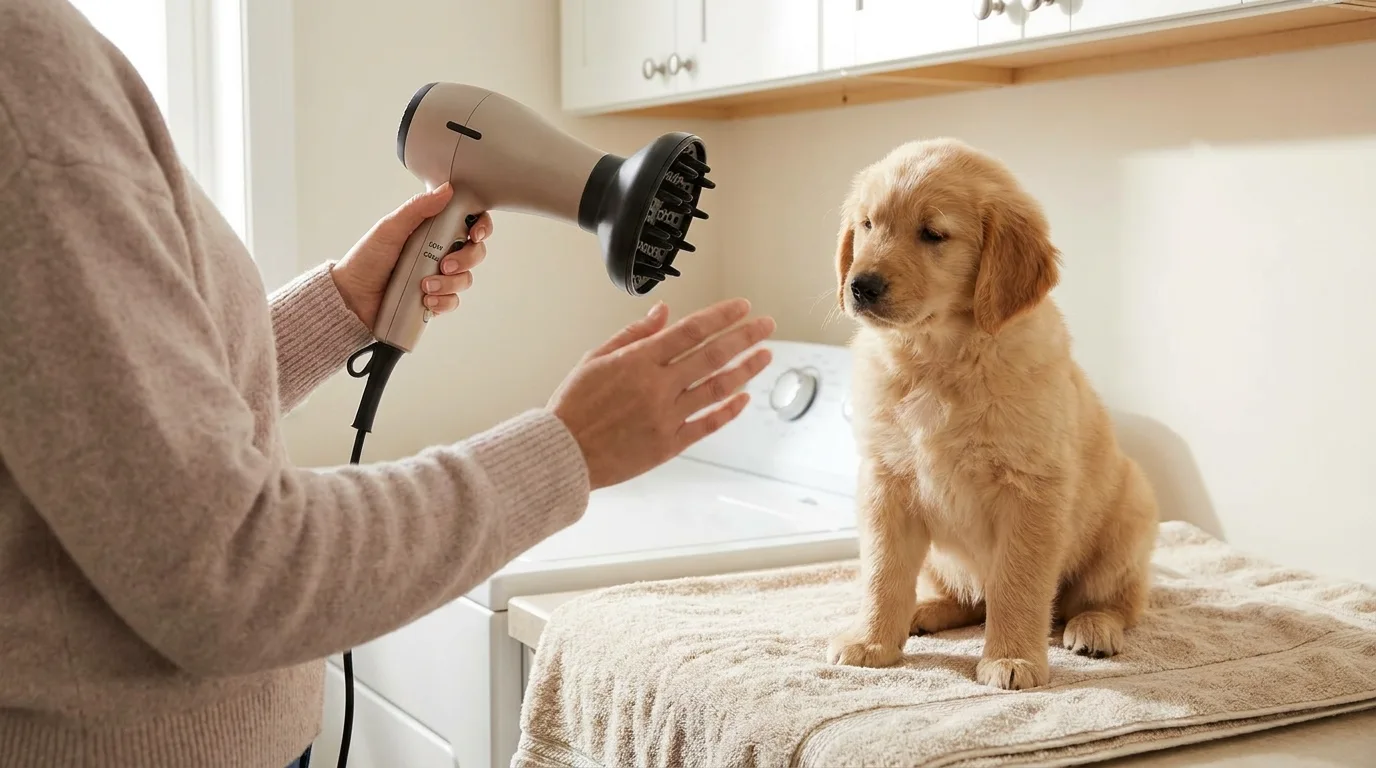
- A pet-safe blow dryer or a standard hair dryer: Pet dryers are quieter (a genuine advantage with noise-sensitive puppies) and often have a dedicated cool setting. A regular human hair dryer works fine as long as you stay on the lowest heat or cool setting.
- A non-slip mat or elevated grooming surface: Trying to dry a wet, squirming puppy on a slippery floor is a recipe for frustration on your part and anxiety on theirs.
- High-value treats: Drying is a training opportunity. Small, soft treats — kept accessible on a nearby surface — turn the experience into something your puppy associates with good things.
- A slicker brush or soft bristle brush: For medium-to-long coats, brushing while drying dramatically speeds up the process and prevents mats from forming as the coat dries.
Warm your towels briefly in the dryer before bath time — especially for young puppies or small breeds. A warm towel makes the transition from warm bath water to the outside air far more comfortable, and many puppies will relax into it rather than squirm away.
How to Dry a Puppy After a Bath — Step by Step
Follow this sequence and the process becomes genuinely manageable, even with a wiggly pup.
- Squeeze, don’t scrub, inside the tub Before lifting your puppy out, use your hands to gently squeeze water from the legs, belly, and tail. This removes a surprising amount of water before the towel phase even begins, which means less saturated towels and a faster dry time overall.
- Wrap immediately in a warm towel Lift your puppy out and wrap them snugly — burrito-style works well for small and medium puppies. Hold them close to your body for 60–90 seconds. The warmth from your own body heat, combined with the towel, starts the drying and calms an anxious pup at the same time.
- Pat and press, never rub This is where most owners go wrong. Rubbing a wet coat — especially a wavy or curly one — tangles the fur and can irritate the skin. Instead, press the towel firmly against sections of the coat and hold for a few seconds, then move to the next section. Work from the body outward to the legs and tail.
- Pay special attention to ears and face Use a separate small towel or corner of the main towel to gently dry the ear flaps and around the face. Water trapped in the ear canal is a common cause of ear infections in puppies — especially floppy-eared breeds like Beagles, Cocker Spaniels, and Dachshunds. Pat gently; never insert anything into the ear canal.
- Switch to a second towel if needed For double-coated, thick, or longer coats, the first towel often becomes saturated quickly. Swap to a fresh one to continue absorbing moisture efficiently.
- Introduce the blow dryer gradually Turn the dryer on before pointing it at your puppy — let them hear the sound from a distance first. Start on the lowest heat or cool setting. Hold the dryer at least 6 inches from the coat and keep it moving constantly in slow, sweeping motions. Never hold it stationary over one spot.
- Check skin temperature with your free hand Periodically touch the skin (not just the coat surface) with your free hand to make sure it doesn’t feel warm or hot. If it does, switch to cool air or take a break. Puppy skin is more sensitive to heat than adult dog skin.
- Brush while drying for medium and long coats For anything beyond a short coat, use a slicker brush or wide-tooth comb to brush through the coat as you dry. This prevents matting, speeds up drying by separating the fur, and leaves the coat looking neat.
- Finish with a full-coat check Once the outer coat feels dry, part the fur with your fingers to check the undercoat near the skin. Especially with double-coated breeds, the topcoat can feel dry while the undercoat is still damp — and that’s where skin problems develop.
- Reward generously and release End with praise, treats, and calm play. You’ve just built a positive association with the entire grooming experience — that investment pays off every single bath time going forward.

How Coat Type Changes Everything
There’s no universal drying approach because puppies come in dramatically different coat types, each with its own drying challenges and timeline. Understanding your puppy’s coat means you can plan accordingly rather than being caught off-guard.
| Coat Type | Examples | Drying Time | Key Notes |
|---|---|---|---|
| Short / Smooth | Beagle, Boxer, Dalmatian | 5–10 min | Towel alone often sufficient; dryer optional |
| Medium / Wavy | Labrador, Golden Retriever, Border Collie | 15–25 min | Towel + dryer; brush while drying to avoid frizz |
| Long / Silky | Maltese, Yorkshire Terrier, Afghan Hound | 20–35 min | Section-dry with brush; tangles form quickly when wet |
| Double Coat | Husky, Pomeranian, Corgi | 25–45 min | Undercoat holds moisture; high-velocity dryer ideal |
| Curly / Non-shedding | Poodle, Bichon, Doodle mixes | 20–30 min | Fluff-dry to prevent tight curls matting down |
| Wire / Rough | Terriers, Schnauzer | 10–20 min | Pat-dry well; wire coats repel water more than others |
Mistakes That Are Surprisingly Common
Even experienced dog owners make these errors — often without realizing the downstream effect on their puppy’s skin, coat, or bath-time behavior.
- Using too-high heat on the blow dryer. This is the most common and most consequential mistake. What feels comfortably warm to your hand can be significantly hotter against skin that’s closer to the dryer’s output. Always go cooler than you think you need to.
- Leaving the undercoat damp. Running your hand over the topcoat and declaring the job done is a mistake with double-coated or thick-coated breeds. The inner layers need the dryer just as much as the outer ones.
- Rubbing the ears dry too aggressively. The inner ear flap is sensitive tissue. Rubbing hard — especially in breeds with thick, heavy ear hair — can cause micro-abrasions or irritate the skin lining. Pat gently.
- Letting your puppy air-dry in a cool room. Air-drying is perfectly fine in a warm, draft-free environment for short-coated puppies in summer. But it’s not a safe assumption year-round or for puppies with thick coats, where the dampness can linger for hours.
- Skipping the ear check entirely. Water in the ear canal is one of the leading causes of recurring ear infections in puppies. After every bath, gently lift the ear flap and pat the outer opening dry. If you notice a smell or discharge, that’s worth a vet call.
- Rushing the blow dryer near the face. Many puppies are particularly sensitive around their eyes and nose. Use the cool setting near the head, or finish the face area with a towel only and let the rest air-dry slightly rather than directing airflow directly at the face.
If your puppy shivers persistently after bathing, develops red or flaky skin, shows discomfort when their ears are touched, or develops a skin odor that wasn’t present before — these are signs worth discussing with your veterinarian. Occasional shivering right after a bath is normal, but prolonged shivering may indicate the puppy is having trouble maintaining body temperature. A vet can also check for ear infection signs that aren’t visible to the naked eye.

Puppy vs Adult Dog — What Changes as They Grow
Young puppies — particularly those under 12 weeks — need more warmth and gentleness during the drying process than older dogs. Their immune systems are still maturing, they tire more easily, and they have less body mass to insulate against heat loss. Keep drying sessions calm, short where possible, and make sure the room is warm before you even start the bath.
As your puppy moves into adolescence (roughly 4–12 months depending on breed), they’ll become more tolerant of the whole process, especially if you’ve built positive associations from the start. Adult dogs who were conditioned to enjoy grooming as puppies are genuinely easier to bathe and dry — it’s a long-term investment that’s very much worth making early.
Breed size plays a role here too. A 7-week-old Chihuahua pup has dramatically less thermal mass than a 10-week-old St. Bernard puppy. Toy and small breed puppies need the warmth and drying attention returned to them faster, while large breed puppies have more insulation but more fur to actually get dry.
Your Bath-Time Drying Checklist
Use this before every bath to make sure you’re ready:
- 2–3 microfiber or absorbent towels pre-warmed if possible
- Blow dryer set to low heat or cool before use
- Non-slip mat or grooming surface ready
- High-value treats accessible within arm’s reach
- Slicker brush or comb for medium-to-long coats
- Room warm and free of cold drafts
- Ear inspection added to the post-bath routine
- Time allocated — don’t rush the drying phase

What About Air-Drying Only?
The honest answer is: it depends. For short-coated puppies in a warm, dry, draft-free room during warmer months, towel-drying followed by supervised air-drying can be perfectly fine. But it’s genuinely not a reliable default — and it’s rarely appropriate for puppies under 12 weeks, small breeds, puppies in cool environments, or any dog with a medium-to-thick coat.
If you do air-dry, keep your puppy in a warm room (ideally above 70°F / 21°C), away from fans and open windows, and check periodically that the skin near the base of the coat is actually drying — not just the outer fur. Never let a wet puppy sleep in a crate or cool surface directly after bathing.
After towel-drying, you can use a drying robe or pet-specific microfiber wrap — these are particularly useful for dogs who dislike the blow dryer. They allow passive drying while your puppy moves around in a contained, warm space, and many dogs find wearing one calming.
When to Call the Groomer or Vet
Most at-home puppy drying is straightforward, but there are situations where professional input is genuinely useful:
- Your puppy has a thick double coat that you can’t seem to get fully dry: A professional groomer with a high-velocity dryer can do this more efficiently and without overheating your puppy. This is especially true for Huskies, Samoyeds, and similar northern breeds.
- You’re seeing persistent skin redness, flaking, or a sour smell: These may indicate a yeast overgrowth or bacterial skin issue that needs veterinary attention — they won’t resolve with different drying technique alone.
- Your puppy shakes their head frequently or scratches at their ears after every bath: This may signal water has entered the ear canal and warrants an ear check from your vet.
- You notice sores, bumps, or patches of hair loss under the coat: These become visible during drying and should be evaluated by a vet rather than waited on.
If your puppy is shaking uncontrollably, seems lethargic, or their gums appear pale after a bath — contact your veterinarian or an emergency animal clinic immediately. These symptoms can indicate hypothermia or another underlying condition that needs urgent attention.

Drying a puppy after a bath isn’t just about getting them fluffy again — it’s a health habit and a training opportunity rolled into one. Start by squeezing out water by hand, then wrap your puppy in a warm towel and use the pat-and-press method rather than rubbing. Follow with a low-heat blow dryer kept at safe distance and in constant motion, paying special attention to the undercoat and ear area.
Coat type determines your timeline — short coats can be done in under 10 minutes, while double or long coats may need 30–45 minutes. Skipping the dryer entirely isn’t always safe, particularly for young, small, or thick-coated puppies in cool environments. And every calm, treat-rewarded drying session you do now is training your dog to enjoy grooming for life.
If anything looks or smells off on the skin or ears after bathing, consult your vet — it’s always better to catch something early than to assume it’ll resolve on its own.