How Long After a Puppy Drinks Do They Pee? The Complete Timing Guide
Quick Answer: Most puppies need to pee within 10 to 30 minutes after drinking water. Very young puppies — 8 to 12 weeks old — often need to go within 5 to 15 minutes. By 4 to 6 months, that window stretches to 20 to 30 minutes or longer. The timing depends on your puppy’s age, size, and individual bladder development, but the rule is consistent: water in equals pee out — and it happens faster than most new owners expect. Take your puppy outside every single time they drink, without exception, and you will dramatically reduce indoor accidents.
You just watched your puppy lap water from the bowl for a solid 30 seconds. Now you are standing in the kitchen, mentally counting down, wondering exactly when the inevitable puddle is going to appear on your floor. You search “how long after a puppy drinks do they pee” because potty training feels less like training and more like a physics equation you cannot quite solve. Water goes in. Pee comes out. But how fast? And how do you stay ahead of it instead of cleaning up after it?
The drink-to-pee window is one of the most predictable patterns in puppy development — and one of the most underutilized tools in potty training. Once you understand the timing, you stop reacting to accidents and start preventing them. This guide gives you the exact timing by age, a simple schedule you can start today, and the troubleshooting advice that makes the difference between a puppy who gets it in a few weeks and one who struggles for months.
The Drink-to-Pee Timeline by Puppy Age
A newborn puppy cannot control their bladder at all. The mother stimulates urination by licking, and the puppy releases reflexively. By 8 weeks — the age when most puppies go to their new homes — voluntary bladder control is just beginning to develop. The sphincter muscles are weak. The bladder is tiny. The nervous system connections that signal “I need to go” are still forming. The result: when water goes in, pee comes out — fast.
The timeline below reflects what most puppy owners can expect. Individual puppies vary. Small and toy breeds tend to have faster drink-to-pee times because their bladders are proportionally even smaller. Large breed puppies may hold it slightly longer, but the difference is measured in minutes, not hours, during the first few months. The rule holds across all breeds: if your puppy just drank, a potty trip is not optional. It is immediate and non-negotiable.
| Puppy Age | Time to Pee After Drinking | Maximum Bladder Capacity (Daytime) | Nighttime |
|---|---|---|---|
| 8 to 10 weeks | 5 to 15 minutes | 30 to 60 minutes | 2 to 3 hours max — set an alarm |
| 10 to 12 weeks | 5 to 15 minutes | 45 to 90 minutes | 3 to 4 hours max |
| 3 to 4 months | 10 to 20 minutes | 1 to 2 hours | 4 to 5 hours |
| 4 to 6 months | 20 to 30 minutes | 2 to 4 hours | 5 to 7 hours — some sleep through |
| 6 to 12 months | 20 to 30+ minutes | 3 to 6 hours | 6 to 8 hours — most sleep through |

Why the Drink-to-Pee Window Is the Key to Potty Training
Most potty training advice focuses on taking the puppy out at regular intervals — every hour, every two hours. That advice is not wrong, but it misses the most predictable trigger of all. A puppy who drank water 5 minutes ago is far more likely to need to pee than a puppy who has been sleeping for an hour and has not had water recently. Time-based schedules help. Trigger-based schedules — where water consumption is the trigger — are more precise.
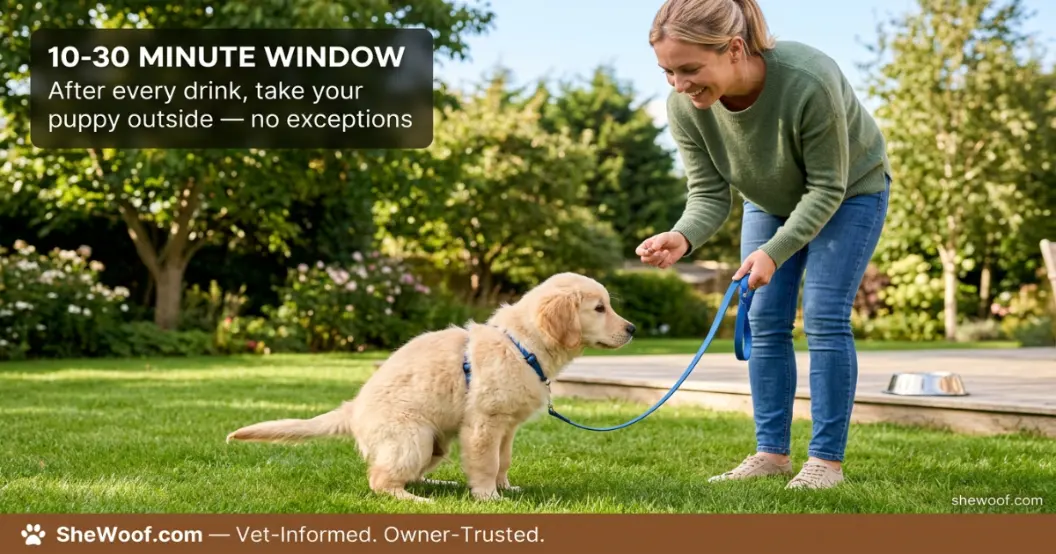
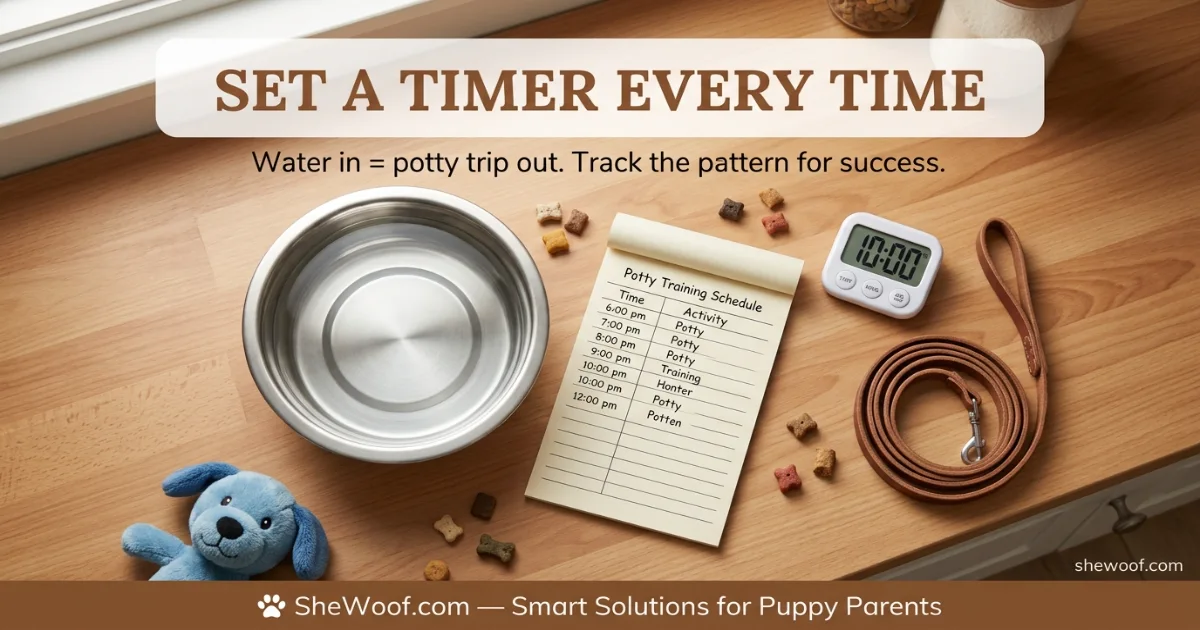
Pair the two approaches. Take your puppy out on a regular schedule: first thing in the morning, after every meal, after every nap, after every play session, and before bedtime. But also — and this is the part that transforms potty training — take them out every single time they drink water, regardless of when they last went. Even if they just came inside from a successful potty trip 15 minutes ago. Even if you are tired. Even if it is raining. Water in equals potty trip out. No exceptions during the training period.
The reason this works is that it removes ambiguity. Your puppy does not have to figure out when to signal you. They do not have to hold it longer than they are physically capable of holding it. The environment — you, the schedule, the immediate potty trip after drinking — does the work for them. Success builds on success. Every outdoor pee is a reinforcement of the correct behavior. Every indoor accident is a missed opportunity that would have been prevented by simply taking them out after they drank.
What Most Owners Get Wrong About Puppy Pee Timing
The most common mistake is waiting for the puppy to signal that they need to go. Puppies under 4 to 5 months do not reliably signal. They do not know they need to go until the urge is urgent — and by then, it is often too late to make it outside. Waiting for a whine, a scratch at the door, or a meaningful look is waiting for a skill your puppy has not developed yet. You are the signal. The schedule is the signal. The water bowl is the signal.
Another frequent error: limiting water to reduce accidents. Restricting water during the day is dangerous. Puppies dehydrate faster than adult dogs, and withholding water to make potty training easier puts their health at risk. Water should be freely available during all waking hours. The solution to accidents is not less water — it is more potty trips. If you are overwhelmed by the frequency, the answer is to adjust your schedule and use containment tools like crates and playpens — not to restrict your puppy’s access to water.
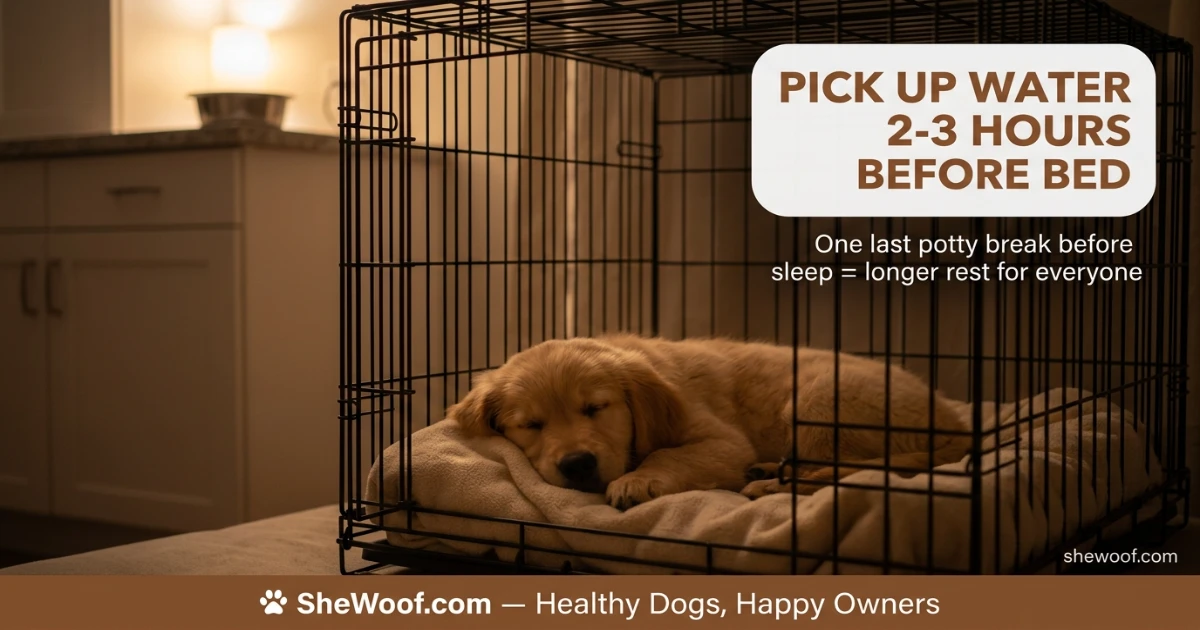
A third mistake involves nighttime water management. Picking up the water bowl 2 to 3 hours before bedtime is appropriate — this gives your puppy time to process the water and pee before sleep. But some owners pick up water too early — 4 or 5 hours before bed — leaving the puppy thirsty and uncomfortable through the evening. Two to three hours is the sweet spot. Enough time to empty the bladder. Not so much time that the puppy goes to bed dehydrated.
How Breed Size Affects the Drink-to-Pee Window
Toy breeds — Chihuahuas, Yorkies, Toy Poodles, Maltese — have the smallest bladders relative to body size and the fastest drink-to-pee times. A 2-pound Chihuahua puppy may need to pee within 5 minutes of drinking. Their bladder capacity is measured in milliliters, not ounces. Owners of toy breeds should expect more frequent potty trips and a longer potty training timeline — not because the puppy is stubborn, but because their physical capacity is genuinely limited.
Medium and large breed puppies — Golden Retrievers, Labradors, German Shepherds — have larger bladders even as young puppies and can typically hold it slightly longer. The difference is real but not enormous during the first 3 to 4 months. A 10-week-old Labrador may hold it for 45 minutes instead of 30. By 6 months, the gap widens significantly — large breed puppies may hold it for 3 to 4 hours during the day while a toy breed of the same age may still need to go every 1 to 2 hours.
Giant breed puppies — Great Danes, Mastiffs — are an interesting case. They have large bladders but also drink large volumes of water. The drink-to-pee window may be similar to medium breeds, but the volume of urine produced is larger. Giant breed puppies also grow so fast that their bladder capacity increases noticeably month to month. What was true at 12 weeks may not be true at 16 weeks. Reassess the schedule regularly as your giant breed puppy grows.

Nighttime and the Last Drink of the Day
Nighttime potty training works differently from daytime. The goal at night is to help your puppy sleep as long as their bladder capacity allows — and to respond when they wake up needing to go. Pick up the water bowl 2 to 3 hours before bedtime. Take your puppy out for a final potty break immediately before you go to sleep. Set an alarm for the middle of the night based on your puppy’s age: every 2 to 3 hours for 8-to-10-week-olds, every 3 to 4 hours for 10-to-12-week-olds, and gradually longer as they grow.
When the alarm goes off — or when your puppy wakes up and whines — take them outside immediately. Keep it boring. No play. No lights. No conversation beyond the potty cue. The message is: nighttime is for sleeping. This potty trip is functional, not fun. After they pee, bring them straight back to their crate or sleeping area. Do not offer water during the night unless your puppy is ill, has diarrhea, or your veterinarian has specifically advised otherwise.
By 4 to 6 months, most puppies can sleep through the night — roughly 6 to 8 hours — without needing a potty break, provided water was picked up a few hours before bed and they emptied their bladder before sleep. Some puppies achieve this earlier. Some take longer. Small and toy breeds often take the longest to develop overnight bladder control simply because their bladders are smaller. This is normal, not a training failure.
Frequently Asked Questions About Puppy Pee Timing
Most puppies need to pee within 10 to 30 minutes after drinking. Very young puppies — 8 to 12 weeks old — often need to go within 5 to 15 minutes. The exact timing depends on age, size, and individual bladder development. Taking your puppy outside every time they drink is the single most effective potty training habit you can build.
A young puppy’s bladder is small and their sphincter muscles are still developing. Water passes through their system quickly — sometimes within 5 to 10 minutes. The urge to urinate hits fast, and they do not yet have the muscle control to delay it. This is normal. It improves as they grow. Until then, take them out immediately after every drink.
Never restrict water during the day. Puppies dehydrate faster than adult dogs, and water is essential for every bodily function. The solution to frequent peeing is more potty trips — not less water. The only appropriate time to pick up the water bowl is 2 to 3 hours before bedtime to support overnight bladder control.
A general rule is that a puppy can hold their bladder for roughly their age in months plus one, up to about 6 to 8 hours for adults. A 2-month-old puppy can hold it for about 2 to 3 hours. A 4-month-old can hold it for about 4 to 5 hours. This is a guideline, not a guarantee — and it resets every time your puppy drinks water.
If your puppy just drank water, woke up from a nap, or finished a play session, assume they need to pee — even if they seem excited. The safest approach is to take them outside first, then engage in play or cuddles. Excitement urination — where a puppy dribbles when greeted — is a separate issue related to emotional development, not bladder control.
Stay outside for 5 to 10 minutes in the designated potty spot. Use your potty cue phrase. If they do not go, bring them back inside and either put them in their crate or keep them on a leash attached to you for 10 to 15 minutes, then try again. Do not give them free run of the house — that is how accidents happen. Repeat until they go, then praise and reward.
Around 5 to 6 months, when your puppy has reliably gone several weeks without an accident and is showing signs of bladder control — holding it between scheduled trips, signaling at the door, or waiting until you take them out. Even then, continue to take them out after the first drink of the morning and the last drink of the evening. Those two trips remain important even for adult dogs.
- Most puppies need to pee within 10 to 30 minutes after drinking water. Very young puppies — 8 to 12 weeks — often need to go within 5 to 15 minutes.
- The drink-to-pee window is the most predictable and underutilized tool in potty training. Take your puppy outside every single time they drink water, without exception.
- Bladder control develops gradually. An 8-week-old puppy can hold it for 30 to 60 minutes during the day. A 6-month-old can hold it for 3 to 6 hours. The timeline varies by breed size.
- Never restrict water during the day to reduce accidents. The only appropriate water restriction is picking up the bowl 2 to 3 hours before bedtime.
- Toy breeds have faster drink-to-pee times and longer potty training timelines — not because they are stubborn, but because their bladders are physically smaller.
- Pair trigger-based potty trips (after drinking, eating, napping, playing) with a consistent schedule, a designated potty spot, and immediate praise for outdoor success.




One Comment