
How Often Should You Give Your Puppy Water? A Complete Hydration Guide
Quick Answer: Puppies should have access to fresh, clean water throughout the day — not just at meal times. Water should be available at all times during waking hours. The only exception is a brief period before bedtime and during the night to support potty training, where water can be picked up about 2 to 3 hours before sleep. A general guideline is approximately half a cup to one cup of water every 2 hours for young puppies, but the exact amount depends on your puppy’s size, age, activity level, and diet. The key principle is free access during the day, managed access at night.
You brought your puppy home, set up the crate, bought the food, and booked the first vet visit. Then a seemingly simple question stops you cold: how often should you give your puppy water? Do you leave the bowl out all day? Pick it up between meals? What about at night — if you leave water in the crate, will you be cleaning up accidents until sunrise? If you take it away, could your puppy get dehydrated? These questions matter. Water is the single most essential nutrient in your puppy’s diet, and getting the rhythm right affects everything from potty training success to kidney health.
This guide answers every layer of the question — from newborn nursing through the first year — with practical schedules, breed-specific considerations, and the signs that tell you whether your puppy is drinking too little, too much, or just right.
Why Puppy Hydration Is Different From Adult Dog Hydration
Puppies are not just smaller versions of adult dogs when it comes to water needs. Their bodies contain a higher percentage of water — up to 80% of their body weight compared to roughly 60% in adults. They have a faster metabolism. Their kidneys are still maturing and cannot concentrate urine as efficiently as adult kidneys can. All of this means puppies lose water more quickly and need to replenish it more frequently.
A puppy who goes without water for too long can become dehydrated faster than an adult dog in the same situation. The smaller the puppy, the faster this can happen. Toy breeds are especially vulnerable because their total body water reserves are tiny. A Chihuahua puppy can show signs of dehydration within hours of water restriction, while a Golden Retriever puppy may tolerate a longer gap — but neither should be tested unnecessarily.
At the same time, puppies have small bladders and developing sphincter control. What goes in must come out — often within 15 to 30 minutes. This is the tension every new owner navigates: keeping the puppy hydrated while also working toward reliable potty training. The solution is not water restriction. It is structured access.

How Often Should You Give Your Puppy Water by Age
A newborn puppy nursing from their mother gets all the hydration they need from milk. No water bowl is necessary until weaning begins around 3 to 4 weeks of age. At that point, a shallow dish of fresh water should be introduced alongside the first soft foods. The water dish at this age should be heavy enough not to tip and shallow enough that the puppy cannot accidentally inhale water or climb in and become chilled.
From 8 weeks — the age when most puppies go to their new homes — through roughly 6 months, water should be available at all times during the day. There is no set number of “water servings” per day. Instead, the bowl stays filled and accessible, and you monitor intake by observing how often the puppy drinks and how much the water level drops. A healthy 8-to-12-week-old puppy typically drinks small amounts frequently throughout the day rather than large amounts at once.
By 6 to 12 months, most puppies can hold their bladder through the night reliably, and many owners transition to leaving a small amount of water available overnight as well — especially for larger breeds who are fully house trained. The need to pick up water before bedtime fades as bladder control matures. Every puppy is individual. Watch your dog’s signals. If they wake up desperate for water, the bowl should have been left down. If they have nighttime accidents, the schedule needs adjustment, not punishment.
| Puppy Age | Water Access | Nighttime | Notes |
|---|---|---|---|
| Birth to 3 weeks | From mother’s milk only | N/A | No water bowl needed |
| 3 to 8 weeks | Shallow dish introduced during weaning | Available | Heavy, tip-proof, shallow bowl |
| 8 weeks to 6 months | Free access all day | Pick up 2-3 hours before bed | Monitor intake; offer frequently |
| 6 to 12 months | Free access all day | Small amount may be left overnight | Adjust based on bladder control |
| 12+ months | Free access at all times | Water available overnight | Adult schedule unless medical issue |
How Much Water Does a Puppy Need Each Day?
The general veterinary guideline is that a healthy puppy needs roughly half an ounce to one ounce of water per pound of body weight per day, split across the waking hours. A 10-pound puppy needs approximately 5 to 10 ounces of water daily. A 20-pound puppy needs about 10 to 20 ounces. These are starting points, not rigid rules.
Several factors push water needs higher. Dry kibble contains only about 10% moisture, while wet or raw food can be 70 to 80% water. A puppy eating exclusively dry food will drink noticeably more water than a puppy on a moisture-rich diet. Hot weather, vigorous play, and any illness that causes vomiting or diarrhea all increase water requirements. A puppy who spent an hour running at the dog park on a warm day needs more water than the same puppy on a quiet, cool afternoon indoors.
The best measure of adequate hydration is not the water bowl — it’s the puppy. A well-hydrated puppy has moist pink gums, elastic skin that snaps back immediately when gently pinched at the scruff, bright eyes, and regular urination of pale yellow urine. Dark, concentrated urine with a strong odor suggests the puppy needs more water. Clear, completely colorless urine may indicate over-drinking, which warrants a veterinary check if it persists.
What Most Owners Get Wrong About Puppy Water
The most harmful mistake owners make is restricting water to control potty accidents. This does not work. A dehydrated puppy still produces urine — just more concentrated urine that can irritate the bladder and increase the risk of urinary tract infections. The accidents do not stop. The puppy just gets thirsty, and the owner loses trust. The correct approach is to keep water freely available during the day and manage the potty schedule, not the water bowl.
Another common error: assuming a puppy will self-regulate perfectly. Most puppies drink when they are thirsty. But very young puppies, puppies in a new environment, or puppies who are distracted by play may forget to drink. Owners should occasionally guide the puppy to the water bowl, especially after active play, walks, or meals. Think of it as a gentle reminder, not force.
A third mistake involves water temperature. Ice-cold water on a hot day can cause stomach cramping or even trigger vomiting in sensitive puppies. Cool, fresh water — not chilled, not warm — is ideal. Some puppies also develop a preference for running water and may drink more readily from a pet fountain than a still bowl. This is a harmless quirk worth accommodating if it improves hydration.

Excessive Drinking: When Too Much Water Is a Problem
While dehydration gets most of the attention, the opposite problem — polydipsia, or excessive drinking — can also signal trouble. A puppy who drains the water bowl repeatedly, asks to go outside constantly to urinate, and produces large volumes of clear urine may have an underlying medical issue. Diabetes insipidus, kidney disease, liver problems, Cushing’s disease, and certain infections can all cause excessive thirst.
Psychogenic polydipsia is a behavioral condition where a dog drinks compulsively without a physical cause. It is more common in certain breeds and in dogs with anxiety or boredom. If your puppy drinks obsessively — to the point of vomiting or urinating inappropriately despite frequent outdoor access — a veterinary evaluation is the first step. Blood work and a urinalysis can rule out or confirm medical causes before a behavioral approach is considered.
Do not restrict water from a puppy who drinks excessively without veterinary guidance. If the excessive drinking has a medical cause, restricting water can worsen the condition rapidly. The vet needs to see the full picture of how much the puppy drinks when unrestricted to make an accurate diagnosis.

Breed, Size, and Environment: How They Change Water Needs
Small breeds and toy breeds have faster metabolisms and smaller fluid reserves. A Yorkshire Terrier puppy may need proportionally more water per pound of body weight than a Great Dane puppy. Large and giant breed puppies drink more total volume but less per pound. Both need consistent access. The difference is in the size of the bowl and the frequency of refills — not in whether water is available.
Flat-faced breeds — Pugs, French Bulldogs, Boston Terriers — are at higher risk for overheating because their shortened airways make panting less efficient. Panting is a dog’s primary cooling mechanism, and it consumes body water. Brachycephalic puppies may need extra encouragement to drink during warm weather and should never have water restricted during the day, especially in summer.
Active puppies burn through water faster. A puppy who spent 30 minutes playing chase in the backyard needs water immediately afterward. Puppies in hot or dry climates need more water than puppies in cool, humid environments. Travel, boarding, vaccinations, and any stressor can temporarily increase water needs. There is no single correct amount. The correct amount is the amount that keeps your individual puppy’s gums pink and moist, their energy normal, and their urine pale yellow.

Frequently Asked Questions About Puppy Water Intake
Water should be freely available at all times during waking hours. There is no set number of servings. Keep a clean bowl filled with fresh water in an accessible location, and gently guide your puppy to it after meals, play, walks, and naps. Puppies typically drink small amounts frequently throughout the day.
For puppies under 6 months who are still developing bladder control, pick up the water bowl 2 to 3 hours before bedtime and take your puppy out for a final potty break right before sleep. For older puppies with reliable overnight bladder control, leaving a small amount of water in the crate overnight is safe. Never restrict water during the day to manage nighttime accidents.
Check your puppy’s gums — they should be moist and pink. Gently pinch the skin at the scruff; it should snap back immediately. Urine should be pale yellow, not dark or concentrated. A puppy who is playing energetically, eating normally, and urinating regularly is usually well-hydrated.
Yes. Excessive drinking — called polydipsia — can signal medical conditions including diabetes, kidney disease, Cushing’s disease, or a urinary tract infection. If your puppy is draining the water bowl repeatedly, producing large amounts of clear urine, and seems unable to quench their thirst, schedule a veterinary evaluation with blood work and urinalysis.
Dry, sticky gums. Skin that stays tented when pinched at the scruff. Sunken eyes. Lethargy. Loss of appetite. Dark, concentrated urine or no urination for several hours. Dehydration in puppies can become serious quickly. Offer water and contact your veterinarian if symptoms persist or worsen.
Yes. Wet or canned food contains 70 to 80% moisture and significantly contributes to daily hydration. Puppies on a wet food diet may drink noticeably less from the water bowl than puppies eating dry kibble. This is normal and not a cause for concern — as long as the puppy is well-hydrated overall and producing normal urine.
A small splash of low-sodium chicken or bone broth can encourage a reluctant puppy to drink. Never add milk, juice, sports drinks, or any sweetened liquid. For puppies who seem uninterested in still water, a pet fountain with running water often increases drinking. Always consult your veterinarian if your puppy consistently refuses water.
- Puppies should have free access to fresh, clean water throughout all waking hours — restricting water during the day is not safe and does not speed up potty training.
- Pick up the water bowl 2 to 3 hours before bedtime for puppies under 6 months to support nighttime bladder control while maintaining healthy daytime hydration.
- A general guideline is half an ounce to one ounce of water per pound of body weight daily, adjusted for activity level, diet type, weather, and individual needs.
- Signs of adequate hydration include moist pink gums, elastic skin, bright eyes, regular urination of pale yellow urine, and normal energy levels.
- Excessive drinking or a complete refusal to drink both warrant veterinary evaluation — do not restrict water from a puppy who drinks heavily without medical guidance.
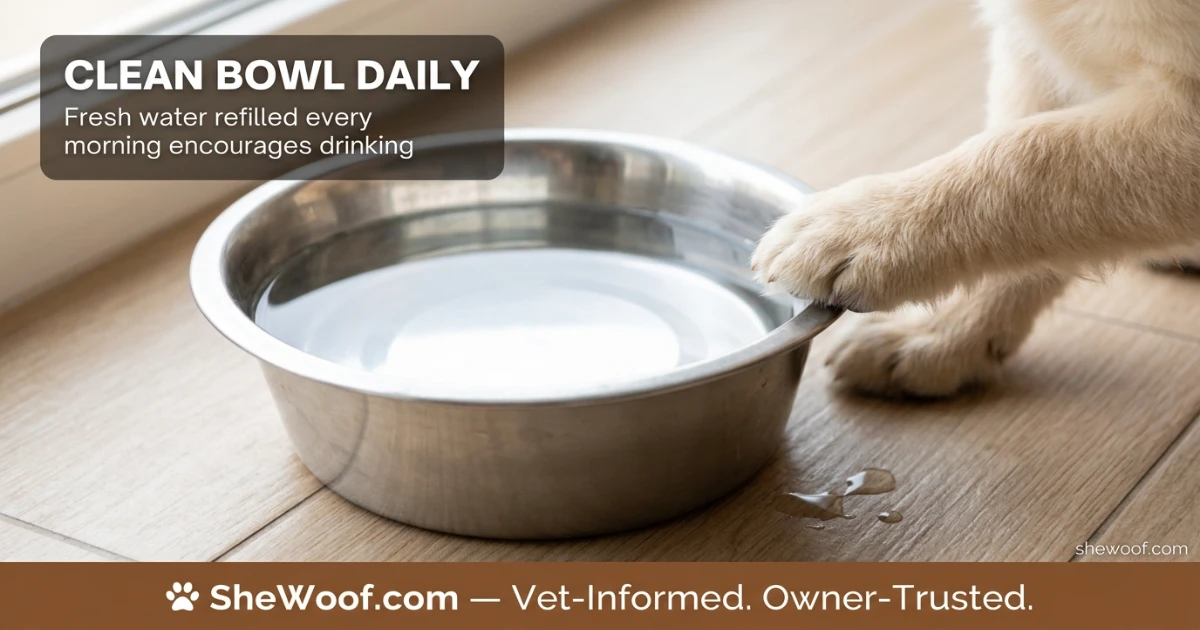
- Wash water bowls daily, place multiple stations around the home, guide your puppy to the bowl after activity, and never leave a puppy without access to water during waking hours.