
How Long Do Golden Retrievers Teeth? A Complete Puppy Teething Timeline
Quick Answer: Golden Retriever puppies begin teething around 3 to 4 weeks of age when their baby teeth emerge. The full set of 28 deciduous teeth is usually present by 6 to 8 weeks. Teething — the process of baby teeth falling out and adult teeth coming in — starts around 12 to 16 weeks and typically finishes by 6 to 7 months of age, when the full set of 42 permanent adult teeth should be in place. The most intense chewing and discomfort happens between 4 and 6 months, during the peak of adult tooth eruption.
Your Golden Retriever puppy was a soft-mouthed angel last week. This week, they’re gnawing on chair legs, your fingers, and anything else that fits between their jaws. If you found this page by searching “how long do golden retrievers teeth,” you are probably standing in the middle of teething chaos — and you need a timeline, not just sympathy. You need to know when this phase ends, what is normal, and what requires a vet’s attention.
Golden Retrievers follow a predictable dental development schedule, just like most medium-to-large breeds. Understanding that timeline makes the difference between months of frustrated guessing and a confident plan. This guide covers every stage of Golden Retriever teething — from the first baby tooth through the last adult molar — with practical, breed-specific advice woven throughout.
The Golden Retriever Teething Timeline: Birth to 7 Months
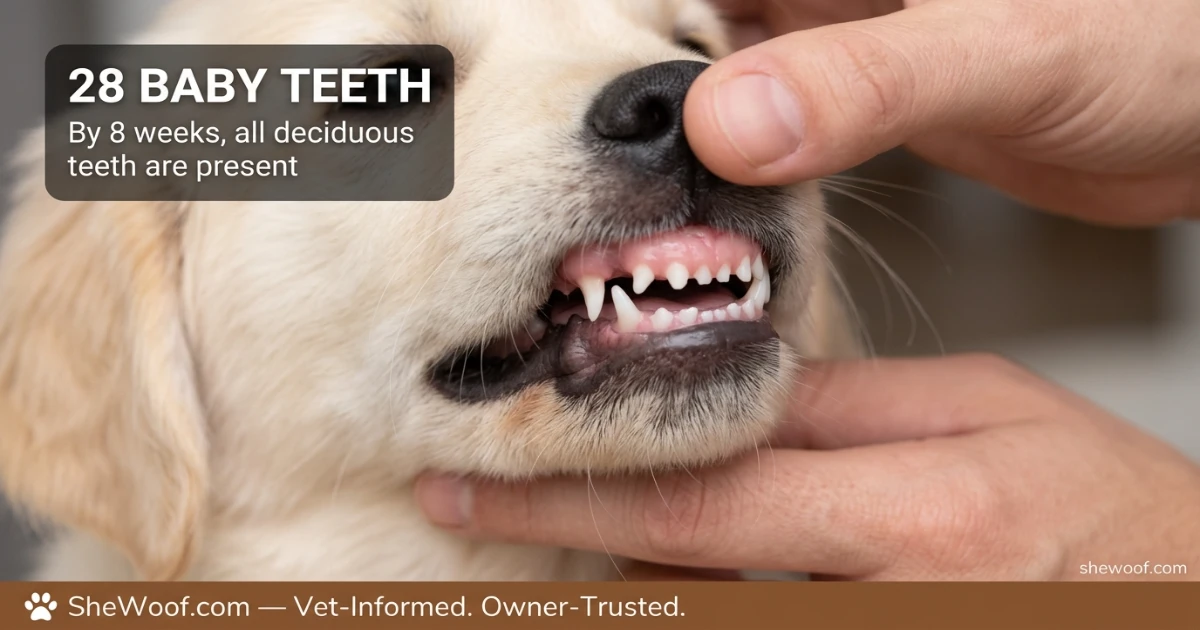
Golden Retriever puppies are born toothless. For the first two to three weeks of life, they rely entirely on nursing, and gums are all they need. Then, around 3 to 4 weeks of age, the first baby teeth — called deciduous teeth — begin to push through. The incisors appear first, followed by the canines around 4 to 5 weeks, and finally the premolars by 6 to 8 weeks. By the time a Golden Retriever puppy is ready to go to their new home at 8 weeks, all 28 baby teeth should be present.
The real teething journey — the one owners feel — begins when those baby teeth start to fall out. This process, called exfoliation, usually starts around 12 to 16 weeks. The incisors are the first to go. You may find tiny rice-sized teeth on the floor, or you may never see them at all — many puppies swallow their baby teeth, which is harmless and completely normal. The adult incisors push through shortly after the baby ones fall out.
Between 4 and 6 months, the teething intensity peaks. Canines and premolars are erupting, and the adult molars — teeth that have no baby predecessors — are breaking through the gums for the first time. This is the stage where chewing behavior becomes almost frantic. Your puppy is not being destructive on purpose. Their mouth genuinely hurts, and chewing provides real relief.
By 6 to 7 months, most Golden Retrievers have their full set of 42 permanent teeth. The last teeth to arrive are typically the large molars at the back of the mouth. If adult teeth are not fully in by 7 months, or if baby teeth are still present alongside adult ones, a veterinary dental evaluation is appropriate.

| Age Range | Teething Stage | What’s Happening |
|---|---|---|
| Birth to 3 weeks | No teeth | Nursing only; gums are soft |
| 3 to 4 weeks | Baby incisors emerge | First teeth visible; may begin weaning |
| 4 to 5 weeks | Baby canines emerge | Sharp pointed teeth appear |
| 6 to 8 weeks | Full baby teeth (28) | All deciduous teeth present; puppy can eat solid food |
| 12 to 16 weeks | Baby teeth begin falling out | Incisors go first; adult incisors emerge |
| 4 to 6 months | Peak teething | Canines, premolars, molars erupting; intense chewing |
| 6 to 7 months | Adult teeth complete (42) | All permanent teeth should be in place |
Baby Teeth vs. Adult Teeth: What Changes in a Golden Retriever’s Mouth
A Golden Retriever puppy has 28 baby teeth. An adult Golden Retriever has 42 permanent teeth. The difference — 14 additional teeth — comes primarily from the molars, which have no baby tooth precursors. Those molars erupt directly through the gums during the 4-to-6-month window, and they are large. This is one reason the later stages of teething can be particularly uncomfortable.
The adult tooth formula for a Golden Retriever includes 12 incisors, 4 canines, 16 premolars, and 10 molars. Golden Retrievers have a breed-typical scissor bite, where the upper incisors slightly overlap the lower incisors. This bite pattern develops as the adult teeth settle into their permanent positions, and it is one of the features a veterinarian evaluates during puppy wellness exams.
Baby teeth are smaller, sharper, and more fragile than adult teeth. They have thinner enamel and shorter roots designed to resorb — dissolve — as the adult tooth pushes from below. When this process works correctly, the baby tooth falls out cleanly, and the adult tooth moves into the space without obstruction.
Signs Your Golden Retriever Puppy Is Teething
Teething signs in Golden Retrievers are hard to miss once you know what to look for. Increased chewing is the most obvious — on toys, furniture, hands, leashes, and anything within reach. You may notice spots of blood on chew toys or in the water bowl. This is normal. The gums bleed slightly as teeth erupt through the surface, and the bleeding stops quickly.
Drooling may increase during teething, even though Golden Retrievers are not typically heavy droolers. Your puppy may paw at their mouth or rub their face against furniture or carpet. Appetite can dip temporarily — chewing kibble hurts when gums are sore, and softening food with warm water for a few days often helps. Some puppies become slightly irritable or restless during the peak weeks, simply because they are uncomfortable and cannot understand why.
You may also find baby teeth — tiny, pointed, sometimes with a small root still attached. Finding them is confirmation that the process is working. Not finding them doesn’t mean anything is wrong. Many are swallowed harmlessly.

What Most Owners Get Wrong About Golden Retriever Teething
The most common mistake is treating aggressive chewing as a behavioral problem rather than a developmental phase. A 5-month-old Golden Retriever who destroys a shoe is not being defiant. They are in pain and seeking relief. Punishment during teething is not only ineffective — it can create anxiety around a process the puppy cannot control. Management — removing tempting items, providing appropriate chews, supervising closely — works far better than correction.
Another error: stopping chew toy access because the puppy destroyed the last one. A destroyed chew toy means it was the wrong toy — not that chews are a bad idea. Golden Retrievers are powerful chewers, especially during the adolescent months when adult teeth are settling and jaw strength is increasing. Choose toys rated for strong chewers. Rotate toys daily to maintain interest. A bored Golden Retriever puppy with aching gums will find something to chew — and it may not be something you approve of.
A third misunderstanding: assuming that once adult teeth are in, dental care can wait. The opposite is true. The months immediately after adult teeth erupt are when lifelong habits — both good and bad — form. Start tooth brushing now. Introduce dental chews now. Schedule that first adult dental check now. Prevention is built in these early months, and it is far easier than treating advanced dental disease in a 5-year-old Golden.
Retained Baby Teeth: When to Involve Your Veterinarian
A retained baby tooth is a deciduous tooth that does not fall out when the adult tooth erupts. You will see two teeth occupying the same space — one small and sharp, one larger and whiter. This is most common with the canine teeth. The adult canine erupts beside the baby canine instead of pushing it out, and both remain in place.
Retained baby teeth cause problems. They crowd the adult tooth, pushing it out of proper alignment. They trap food and debris between the two teeth, accelerating plaque and tartar buildup. And they can damage the developing adult bite, creating a malocclusion that may require orthodontic correction later. If you notice a retained baby tooth — especially if the adult tooth is fully visible beside it — schedule a veterinary appointment. The baby tooth typically needs to be extracted under anesthesia, often at the same time as spay or neuter surgery.
Adult Dental Care: What Happens After Teething Ends
The end of teething is not the end of dental responsibility. It is the beginning of a lifelong commitment. Golden Retrievers are prone to periodontal disease — inflammation and infection of the gums and supporting structures of the teeth — as they age. Regular dental care starting in puppyhood is the single most effective prevention strategy.
Brushing your Golden Retriever’s teeth should become a daily or near-daily routine. Use a dog-specific enzymatic toothpaste — never human toothpaste, which contains fluoride and sometimes xylitol, both toxic to dogs. A soft-bristled toothbrush or a finger brush works well. Focus on the outer surfaces of the teeth where plaque accumulates most heavily. Even 30 seconds of brushing makes a meaningful difference.
Dental chews, water additives, and dental diets approved by the Veterinary Oral Health Council can supplement brushing but should not replace it. Nothing cleans below the gum line the way mechanical brushing does. Annual veterinary dental exams — and professional cleanings when recommended — catch problems before they become painful, expensive emergencies.

A routine veterinary dental cleaning for a Golden Retriever typically costs $300 to $700 depending on your location and whether extractions are needed. This includes pre-anesthetic blood work, anesthesia, scaling above and below the gum line, polishing, and a full oral examination. Pet insurance with dental coverage can reimburse a significant portion. Budgeting for an annual or biennial professional cleaning is a realistic part of responsible Golden Retriever ownership.
When Teething Problems Require a Vet Visit
Most Golden Retrievers sail through teething without complications. But certain signs warrant a veterinary exam. If your puppy seems in significant pain — crying when chewing, refusing food for more than 24 hours, or showing swelling around the mouth — something more than normal teething may be happening. Broken baby teeth with exposed pulp can become infected and painful. Retained teeth, as discussed, need extraction. And occasionally, a tooth may be impacted — stuck below the gum line and unable to erupt normally.
Malocclusion — a misaligned bite — can sometimes be identified during the teething phase. If the lower jaw appears to be growing faster than the upper jaw, or if teeth are visibly pointing in the wrong direction, early veterinary assessment can determine whether intervention is needed. Some bite issues correct themselves as the jaw finishes growing. Others do not and benefit from early orthodontic guidance.

Frequently Asked Questions About Golden Retriever Teething
Golden Retriever puppies actively teeth from about 12 weeks to 6 or 7 months of age. The peak intensity — when chewing behavior is strongest and discomfort is most noticeable — occurs between 4 and 6 months. By 7 months, the full set of 42 adult teeth should be in place and the teething phase is complete.
Golden Retriever puppies have 28 deciduous baby teeth. These include 12 incisors, 4 canines, and 12 premolars. Puppies do not have baby molars — those arrive only as adult teeth. By adulthood, a Golden Retriever has 42 permanent teeth, which is 14 more than their puppy set.
Frozen rubber chew toys, frozen whole carrots, and a frozen damp washcloth provide safe, cold relief that numbs sore gums. Avoid ice cubes, antlers, bones, and hard nylon chews, which can crack immature teeth. Never give human pain medications — they can be toxic or fatal to dogs. If your puppy seems to be in significant pain, consult your veterinarian for dog-safe options.
Yes, small amounts of blood on chew toys or in the water bowl are normal during active teething. The gums bleed slightly as teeth erupt through the surface, and the bleeding typically stops quickly. If bleeding is heavy, persistent, or accompanied by swelling or refusal to eat, see your veterinarian.
Start brushing as early as 8 to 12 weeks, using a dog-specific enzymatic toothpaste and a soft finger brush. Early introduction makes tooth brushing a normal, accepted routine. By the time adult teeth are fully in at 7 months, daily brushing should be an established habit for lifelong dental health.
If adult teeth are erupting beside retained baby teeth — especially the canines — schedule a veterinary appointment. Retained deciduous teeth can crowd adult teeth, trap debris, and cause malocclusion. They typically need surgical extraction, which is often performed during spay or neuter surgery.
Golden Retrievers are not uniquely prone to major dental abnormalities, but they are at risk for periodontal disease as they age — like most medium-to-large breeds. Consistent home dental care and annual veterinary oral exams are the most effective prevention. Some Goldens may develop malocclusions or retained teeth that require veterinary attention during puppyhood.
- Golden Retriever puppies have 28 baby teeth by 6 to 8 weeks, begin losing them around 12 to 16 weeks, and should have all 42 adult teeth in place by 6 to 7 months of age.
- Peak teething discomfort and chewing intensity occurs between 4 and 6 months, when the large adult canines and molars are erupting through the gums.
- Provide frozen rubber toys, frozen carrots, and frozen damp washcloths for safe cold relief — avoid ice cubes, antlers, bones, and hard nylon chews during teething.
- Retained baby teeth that persist after the adult tooth has erupted require veterinary extraction to prevent bite misalignment, crowding, and early dental disease.
- Start tooth brushing with dog-specific enzymatic toothpaste during puppyhood and schedule annual veterinary dental evaluations to maintain lifelong oral health.