What Kind of Treats for Cavalier Training? A Breed-Specific Guide
Quick Answer: The best treats for Cavalier King Charles Spaniel training are tiny — about the size of a pea or smaller — soft, smelly, and easy to chew quickly. Think freeze-dried liver cut into minuscule pieces, soft training treats broken into thirds, or small cubes of plain boiled chicken. Cavaliers are highly food-motivated, which makes training a joy, but they also gain weight easily on a small frame. Every treat must be accounted for in their daily calorie intake. Low-calorie, high-value options that prioritize smell over size work best for this sensitive, eager-to-please breed.
Your Cavalier King Charles Spaniel tilts their head, ears cocked, eyes locked on yours. They want to please you. They also want the treat in your hand — probably more than anything else in the room. Cavaliers are famously food-motivated, which makes treat-based training wonderfully effective with this breed. But ask “what kind of treats for cavalier training” in a room full of Cavalier owners, and you will get wildly different answers — because the wrong treats can derail training as quickly as the right ones can accelerate it.
Cavaliers sit at a specific intersection of breed traits that shapes every treat decision. They are small — typically 13 to 18 pounds — which means every calorie counts and weight gain happens fast. They are sensitive — harsh corrections shut them down. They are prone to mitral valve disease, and excessive sodium is a legitimate concern for heart health. They are also, on the upside, enthusiastic eaters who will work enthusiastically for a treat the size of a lentil. This guide builds a treat strategy specifically for the Cavalier — what to use, what to skip, how to manage calories, and how to keep training joyful for a dog who genuinely wants to get it right.
Why Cavaliers Need a Different Treat Strategy Than Other Breeds
Cavalier King Charles Spaniels are not Labrador Retrievers. They do not have the same calorie budget, the same jaw strength, or the same genetic health profile. Treats that work beautifully for a 60-pound active breed can cause weight gain, digestive upset, or long-term health problems in a 15-pound Cavalier. The breed’s specific needs drive every recommendation in this guide.
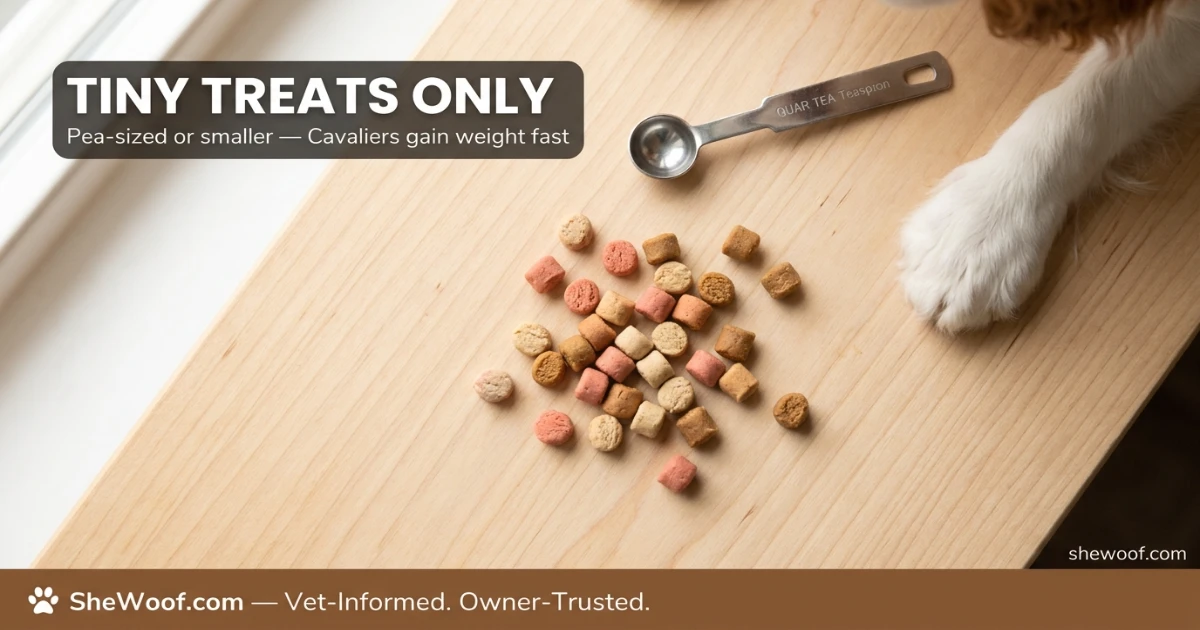
First, the size factor. An adult Cavalier typically weighs between 13 and 18 pounds. A single large milk bone can represent 10% or more of their daily calorie requirement — the equivalent of a human eating an extra meal as a snack. Treats must be tiny. Not small. Tiny. A pea is the upper limit. A lentil or half a blueberry is even better for high-repetition training sessions where your dog may earn 20 to 30 rewards in a single session.
Second, the heart. Cavaliers have one of the highest rates of mitral valve disease of any breed. By age 5, approximately 50% of Cavaliers show some signs of MVD. By age 10, nearly all do. While treats do not cause heart disease, high-sodium treats can exacerbate fluid retention in dogs with compromised heart function. Low-sodium options — and awareness of sodium content in commercial treats — should be part of every Cavalier owner’s treat selection process. This is not about fear. It is about stacking the odds in favor of a longer, healthier life.
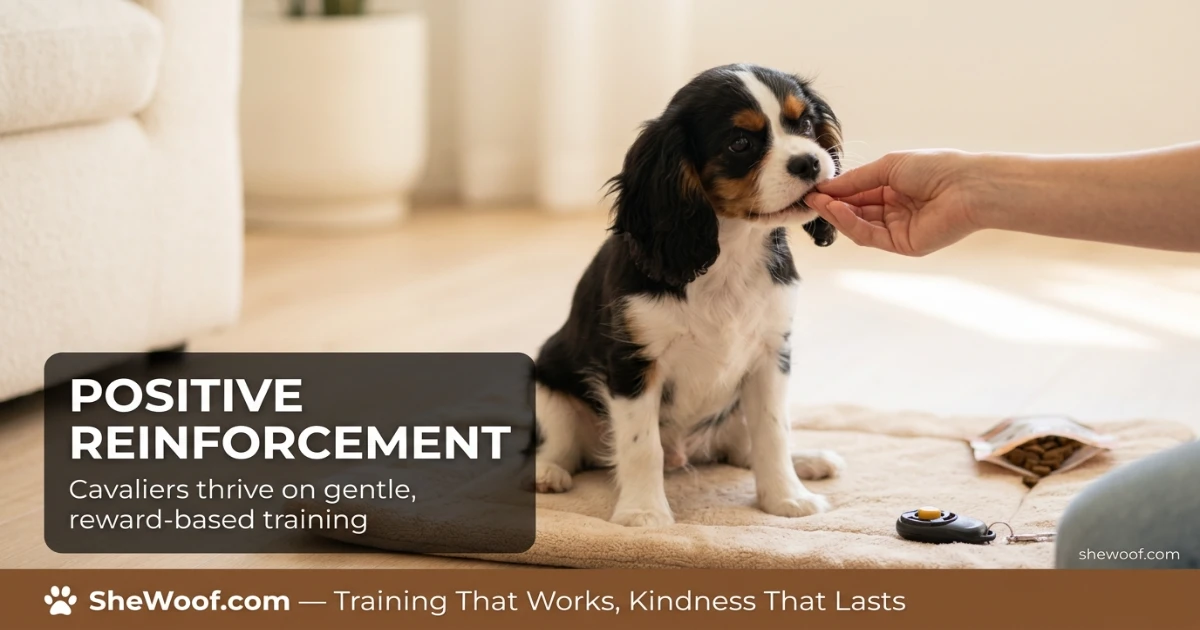
Third, the temperament. Cavaliers are soft dogs. They shut down under harsh handling. Training must be positive, encouraging, and fast-paced enough to hold their attention without frustration. The right treat — something they genuinely love, delivered immediately and paired with warm praise — turns a training session into the highlight of their day. The wrong treat — something dry, crumbly, or uninteresting — loses their focus and wastes your time.

The Best Treat Types for Cavalier Training
The ideal Cavalier training treat hits four criteria: it is very small, it is soft enough to swallow without crunching, it smells strongly, and it is low in calories relative to its motivational power. Freeze-dried liver — a classic training treat — checks every box. It can be broken into pieces smaller than a pea. It has an intense aroma that travels. Most dogs find it irresistible. The calorie count is manageable when portions are controlled.
Soft commercial training treats designed for small dogs are another excellent option. Brands like Zuke’s Mini Naturals, Cloud Star Tricky Trainers, and Pet Botanics Training Rewards are popular among Cavalier owners for good reason. Each treat is roughly 2 to 3 calories when given whole — and they can be broken in half or thirds for even lighter rewards. The texture is chewy and soft, which means the dog swallows quickly and returns focus to you instead of spending 15 seconds crunching a biscuit.
Homemade options give you complete control over ingredients and portion size. Plain boiled chicken breast, cut into cubes no larger than a pencil eraser, is a high-value, low-fat, low-sodium reward that virtually every Cavalier loves. Tiny cubes of low-fat mozzarella string cheese — about the size of a lentil — work wonderfully for high-distraction training situations where you need extra motivational power. The key with cheese is portion control. Three or four tiny cubes during a training session is reasonable. A handful is not.
| Treat Type | Why It Works for Cavaliers | Calories (approx) | Best Use |
|---|---|---|---|
| Freeze-dried liver (broken) | Intense smell, tiny pieces, high-value | ~3-5 per piece | New behaviors, recall, distraction |
| Zuke’s Mini Naturals (halved) | Soft, small, designed for training | ~1-2 per half | Everyday training, high reps |
| Boiled chicken (pencil-eraser size) | Lean protein, low sodium, homemade | ~3-5 per cube | High-value reward, recall proofing |
| Low-fat mozzarella (lentil-sized) | Very high-value, soft, aromatic | ~5-8 per tiny cube | Difficult distractions, vet visits |
| Baby carrots (cut into quarters) | Crunchy, low-calorie, healthy | ~1-2 per quarter | Low-value rewards, between meals |
| Blueberries (halved) | Antioxidant-rich, sweet, juicy | ~1 per half | Occasional novelty reward |
What Most Owners Get Wrong About Treats for Cavaliers
The biggest mistake Cavalier owners make is not counting treat calories at all. A few treats during training. A biscuit when they come inside. A dental chew before bed. A scrap of cheese while cooking. Individually, each is tiny. Cumulatively, they can equal an extra 100 calories per day — roughly 25 to 30% of the dog’s total energy requirement. Over weeks and months, this is how a Cavalier quietly becomes overweight, and excess weight puts additional strain on a heart that may already be vulnerable.
A second common error: using crunchy biscuits or hard treats during training. Every second your Cavalier spends crunching is a second they are not focused on you. Training momentum stalls. The dog wanders off to finish chewing, or crumbs scatter across the floor and the dog starts vacuuming instead of working. Soft treats that can be swallowed in under a second keep the session moving. Hard treats have their place — as occasional chews, not as training rewards.
A third mistake involves treat value. Not all rewards are equal to a Cavalier, and using the same treat for every situation flattens your training leverage. A low-value treat — like a piece of kibble or a bland biscuit — is fine for reinforcing a behavior the dog already knows in a quiet environment. A high-value treat — like chicken or cheese — should be reserved for new skills, high-distraction environments, and recall training. Treat value should match the difficulty of the task. This is not spoiling your dog. It is smart training.
Treats to Avoid or Limit for Cavaliers
Some treats that are marketed for dogs are poor choices for Cavaliers specifically. High-fat treats — including many soft commercial chews, bacon-flavored strips, and cheese-heavy products — can trigger pancreatitis in small breeds. Cavaliers are not uniquely prone to pancreatitis, but their small size means a fatty treat that a Labrador handles without issue represents a much larger metabolic load for a Cavalier. One fatty meal can trigger an episode that requires hospitalization.
Rawhide is problematic for Cavaliers for the same reason it is problematic for most dogs: it is indigestible, can cause choking or intestinal blockages, and often contains chemical residues from processing. Greenies and similar dental chews can be part of a Cavalier’s routine but should be the appropriate size — “petite” or “small” — and should count toward the daily calorie and treat budget. They are not calorie-free. A single small Greenie is roughly 50 to 60 calories, or about 15% of a Cavalier’s daily intake.
High-sodium commercial treats — jerky, some soft treats, and many biscuit-style products — should be minimized, particularly for Cavaliers over age 5 or any dog with a known heart murmur. Check the label. If sodium is listed among the first few ingredients, or if the guaranteed analysis shows more than 0.3% to 0.5% sodium on a dry matter basis, consider a lower-sodium alternative. This is a long-game health decision, not an immediate danger. But for a breed where heart disease is the leading cause of death, the long game matters.
Training Treats for Cavalier Puppies vs. Adults
Cavalier puppies under 6 months have even smaller calorie budgets than adults, and their digestive systems are more sensitive. Treats should be extraordinarily small — think half a lentil, not half a pea. Puppies are also in a critical socialization and learning window. High-value treats used generously during this period pay dividends for years. Do not skimp on treat quality during puppyhood because you are worried about spoiling them. You are building neural pathways. The treats are tools, not bribes.
Puppy-specific training treats tend to be softer and easier to chew than adult versions. Zuke’s Puppy Naturals and similar products are formulated with DHA for brain development and are sized appropriately for small-breed puppies. Homemade boiled chicken and tiny cheese cubes remain excellent options. Avoid any treat that requires sustained chewing — puppies have shorter attention spans than adults, and a treat that takes 30 seconds to eat disrupts the rhythm of a training session entirely.
Adult Cavaliers can handle slightly larger treats — but “slightly larger” still means pea-sized. The treat strategy does not change much from puppyhood to adulthood for this breed. What changes is the total daily calorie budget, which increases modestly. An adult Cavalier who is spayed or neutered and living a moderately active lifestyle needs roughly 350 to 400 calories per day. Treats should represent no more than 35 to 40 of those calories. That is roughly 10 to 15 tiny training treats, or 2 to 3 small cubes of chicken — for the entire day. Every treat counts.
Building a Complete Training Treat System
Experienced Cavalier trainers often use a three-tier treat system. Tier one: everyday rewards — low-calorie, still motivating, used for reinforcing known behaviors at home. Examples include halved Zuke’s Minis, quartered baby carrots, or a single piece of the dog’s own kibble reserved from the meal. Tier two: high-value rewards — used for new behaviors, proofing, and moderate distractions. Examples include freeze-dried liver pieces, small cubes of boiled chicken, or a commercial soft treat your dog goes especially wild for. Tier three: jackpot rewards — used for breakthroughs, recall in high-distraction environments, and exceptionally difficult tasks. Examples include a tiny cube of cheese, a flake of salmon, or a piece of freeze-dried beef lung.
This system prevents your dog from becoming bored with a single treat type while ensuring you always have the right level of motivation for the situation. It also helps with calorie management. When 80% of your training rewards are tier-one low-calorie options, the occasional tier-three jackpot does not derail the diet.
Frequently Asked Questions About Cavalier Training Treats
High-value, aromatic treats work best for recall training with Cavaliers. Tiny cubes of boiled chicken, freeze-dried liver pieces, or a lentil-sized piece of low-fat mozzarella are excellent choices. The treat needs to be more motivating than whatever distraction is competing for your dog’s attention. Reserve these high-value options exclusively for recall and other high-stakes skills.
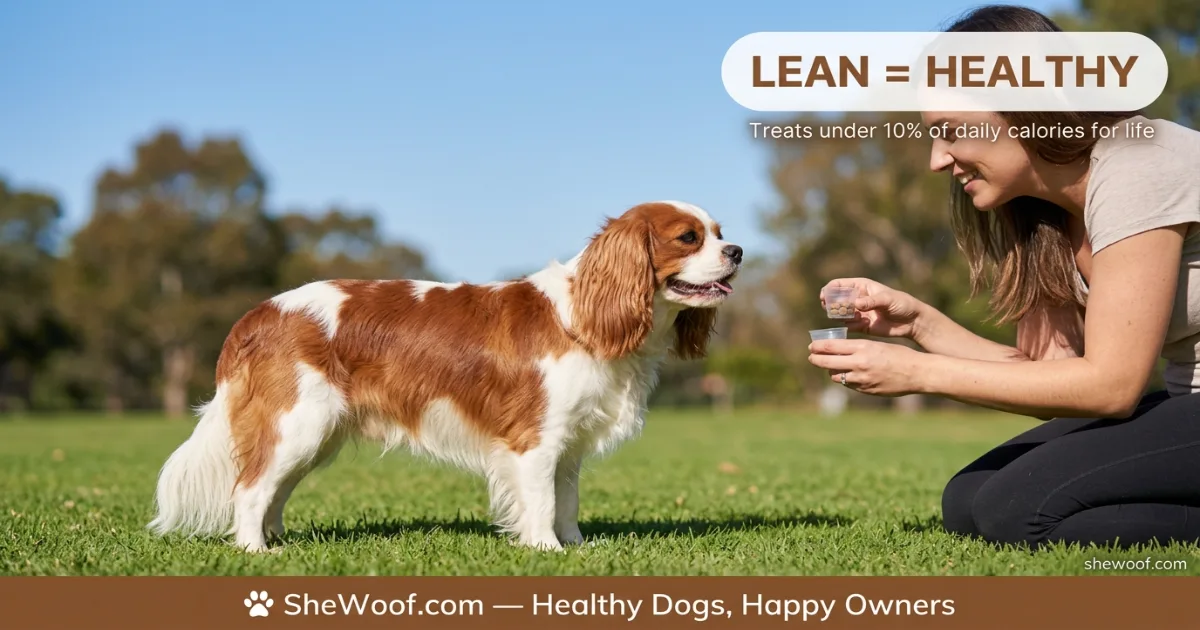
Treats should make up no more than 10% of your Cavalier’s daily calories — approximately 35 to 40 calories for a 15-pound dog. This equals roughly 10 to 15 tiny commercial training treats, or 2 to 3 small cubes of boiled chicken, for the entire day. On heavy training days, subtract treat calories from the next meal to maintain caloric balance.
Yes, in very small amounts. Low-fat mozzarella string cheese cut into lentil-sized cubes is a high-value training treat that most Cavaliers love. Limit to 3 to 5 tiny cubes per session. Avoid high-fat cheeses and never give large pieces. Cheese is calorie-dense, and even small amounts add up quickly on a small dog’s calorie budget.
Avoid high-fat treats that can trigger pancreatitis, high-sodium treats if your Cavalier has a heart murmur, rawhide (choking and blockage risk), and any human foods toxic to dogs including chocolate, grapes, raisins, onions, garlic, and xylitol. Hard bones and antlers can fracture Cavalier teeth and should also be avoided.
Yes. Training treats should be much smaller, softer, and quicker to eat than regular treats. A treat that takes 15 seconds to chew interrupts training flow. Training treats should be swallowable in under 2 seconds. Regular biscuits or dental chews can be given outside of training sessions but should still be accounted for in daily calorie totals.
Yes, for low-distraction, at-home training of behaviors your dog already knows. Reserve a portion of your dog’s meal kibble and use it as low-value rewards. For new skills, high-distraction environments, or recall work, kibble is usually not motivating enough for a Cavalier. Upgrade to a higher-value option when the task difficulty increases.
Quartered baby carrots, halved blueberries, halved Zuke’s Mini Naturals (about 1 calorie per half), and tiny pieces of freeze-dried liver (broken to lentil size, roughly 1-2 calories per piece). Homemade options like pencil-eraser-sized boiled chicken pieces are also low in calories when portioned correctly. The key is the size — not the type — for calorie control.
- The best training treats for Cavaliers are tiny — pea-sized or smaller — soft, aromatic, and quick to swallow so training momentum stays strong and calories stay controlled.
- Treats should make up no more than 10% of daily calories (roughly 35-40 calories for a 15-pound Cavalier). On heavy training days, subtract treats from the next meal.
- Use a three-tier treat system: low-value for known behaviors, high-value for new skills, and jackpot rewards for recall and high-distraction proofing.
- Avoid high-fat treats that risk pancreatitis, high-sodium treats for dogs with heart murmurs, rawhide, hard bones, antlers, and any human foods toxic to dogs.
- Homemade options like boiled chicken breast and tiny low-fat cheese cubes give you complete control over ingredients, sodium, and portion size.
- Rotate treat types every few days to maintain novelty. Deliver rewards within one second of correct behavior, paired with calm, warm praise.