Why Would a Dog Eat Rocks? Causes, Risks, and How to Stop It
Quick Answer: A dog may eat rocks because of a medical condition called pica, nutritional deficiencies, teething, boredom, anxiety, or a compulsive behavioral disorder. Rock eating is dangerous — it can cause choking, broken teeth, intestinal blockages, and internal injuries. If your dog has swallowed a rock, contact your veterinarian immediately. Treatment involves ruling out medical causes, managing the behavior with training and enrichment, and in severe cases, professional behavioral intervention.
You look over at your dog in the yard. They are not chasing a ball or sniffing a bush. They are chewing on a rock. Not a piece of kibble that fell in the grass — an actual stone. If you are wondering why would a dog eat rocks, you are not alone. It is one of the most alarming and dangerous behaviors owners witness, and it rarely resolves on its own without intervention. Rock eating — technically a form of pica — is a serious concern that deserves prompt attention.
Dogs eat rocks for many reasons. Some are medical. Some are behavioral. Some are rooted in boredom, anxiety, or a nutritional gap. Understanding the cause is the first step toward stopping the behavior before it causes a life-threatening emergency. This guide covers the most common reasons, the risks, what to do if your dog has already swallowed a rock, and how to prevent it from happening again.
What Is Pica and Why Does It Cause Rock Eating?
Pica is the medical term for eating non-food items. In dogs, pica can involve rocks, dirt, fabric, plastic, paper, or even metal. It is not a single disease — it is a symptom that can stem from several different underlying causes. When a dog eats rocks specifically, the behavior falls under the pica umbrella and should always be taken seriously.
Rock eating differs from normal puppy mouthing. Puppies explore the world with their mouths and may pick up a rock out of curiosity, but they usually spit it out. A dog with pica actively seeks out and consumes non-food items repeatedly. That distinction matters, because the treatment approach is different. Occasional mouthing is a training issue. Repeated rock eating is often a medical or behavioral problem that needs professional assessment.

Why Would a Dog Eat Rocks? The Most Common Causes
The reasons behind rock eating fall into a few broad categories: medical, nutritional, behavioral, and psychological. Some dogs have more than one contributing factor. Here are the most common causes veterinarians and behaviorists look for.
1. Medical Conditions and Pica
Certain medical conditions can trigger pica in dogs. Anemia, liver disease, pancreatic disorders, and gastrointestinal conditions like inflammatory bowel disease have all been linked to eating non-food items. Some dogs with pica have underlying malabsorption issues that make them feel hungry for nutrients they are not getting. A veterinarian can run blood work and other diagnostics to rule these out.
In some cases, pica is a symptom of a serious health problem that would otherwise go unnoticed. This is why any dog who suddenly starts eating rocks should have a veterinary exam before behavioral treatment is considered. The behavior may be the first visible sign of something wrong internally.
2. Nutritional Deficiencies
Dogs on poor-quality diets or unbalanced homemade diets may develop mineral or vitamin deficiencies that drive them to seek out non-food items. Iron deficiency, in particular, has been associated with pica in dogs. Some dogs respond well to a switch to a high-quality, balanced commercial diet or targeted supplementation under veterinary guidance.
A dog’s body sometimes craves what it is missing. When that craving is for minerals like iron or zinc, the dog may start eating dirt or rocks in an attempt to fill the gap. A veterinary nutritionist or general practitioner can evaluate your dog’s diet and recommend appropriate changes.
3. Teething and Exploration in Puppies
Puppies explore everything with their mouths. During the teething phase — roughly three to eight months of age — they chew on everything from furniture to shoes to rocks. The urge to chew is strong, and rocks are easy to pick up. Most puppies outgrow this with supervision, training, and appropriate chew toys. Some do not, especially if the behavior was inadvertently reinforced or if the puppy has an underlying issue.
4. Boredom and Lack of Enrichment
A dog who has nothing to do will find something to do. If a dog is left alone in a yard with nothing to engage their mind, rocks may become a source of entertainment. The behavior is more common in dogs who are under-exercised, under-stimulated, or left alone for long periods. Adding enrichment — puzzle toys, training sessions, structured play, and more exercise — often reduces or eliminates rock eating.
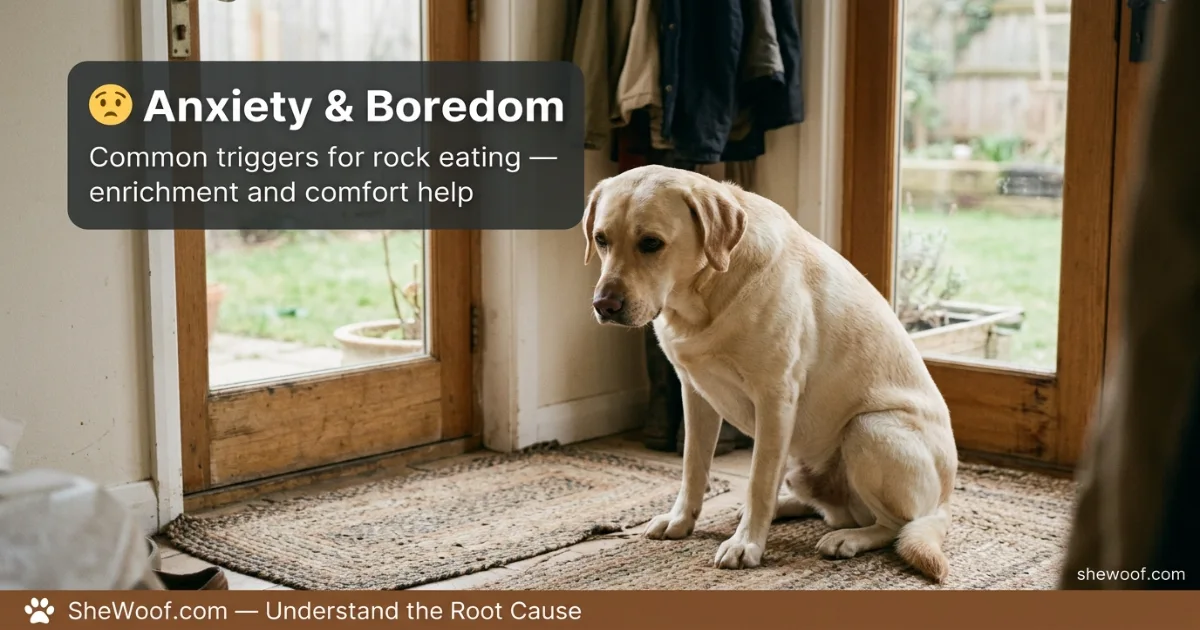
5. Anxiety and Stress
Some dogs eat rocks as a stress response. Separation anxiety, changes in routine, loud noises, or a chaotic household can all trigger compulsive behaviors that include eating non-food items. Rock eating becomes a way to self-soothe. If the underlying anxiety is not addressed, the behavior will not stop.
6. Compulsive Behavioral Disorder
In some dogs, rock eating becomes a genuine compulsion — a repetitive behavior that the dog cannot stop even when they want to. Compulsive disorders in dogs are similar to obsessive-compulsive disorders in humans. They often require a combination of behavioral therapy, environmental management, and in some cases, medication prescribed by a veterinary behaviorist.
Why Rock Eating Is So Dangerous
Rock eating is not a harmless quirk. It is a behavior that can cause serious injury or death. Even a small rock can create a life-threatening emergency.
- Choking: A rock can lodge in the throat or windpipe, blocking airflow.
- Broken teeth: Chewing on rocks can fracture or break teeth, requiring extraction or root canals.
- Mouth and tongue injuries: Sharp rocks can cut the gums, tongue, and soft palate.
- Esophageal damage: A swallowed rock can scratch or tear the esophagus.
- Intestinal blockage: Rocks can become stuck in the stomach or intestines, requiring emergency surgery.
- Intestinal perforation: Sharp rocks can pierce the intestinal wall, causing peritonitis — a life-threatening infection.
- Chronic gastritis: Even small rocks that pass through can cause ongoing stomach irritation.
The most common emergency is intestinal blockage. When a rock is too large to pass through the intestines, it stops the flow of food and waste. The dog begins vomiting, becomes lethargic, and can deteriorate quickly. Surgery is often required. Left untreated, a blockage can be fatal.
What Should You Do If Your Dog Ate a Rock?
If you know or suspect your dog has swallowed a rock, act quickly. Do not wait to see if symptoms appear. Even if your dog seems fine, the rock may be slowly moving through the digestive tract and could become stuck at any point.
- Call your veterinarian or an emergency clinic immediately. Describe the size of the rock and when you think your dog swallowed it. The vet will advise whether to come in right away or monitor at home.
- Do not induce vomiting. Never try to make your dog throw up a rock. A rock coming back up can cause as much damage to the esophagus as it did going down.
- Do not give food or water if the vet advises against it. If a blockage is suspected, withholding food may be necessary for imaging and treatment.
- Watch for warning signs over the next 72 hours. Symptoms of blockage or perforation include vomiting, lethargy, loss of appetite, abdominal pain, straining to defecate, and blood in stool.
- Bring the rock if you have it. If your dog vomited the rock or you found it nearby, bring it to the vet. Knowing the size and shape helps them assess the risk.
- Follow your vet’s recommendations exactly. Some rocks can pass through with monitoring. Others require endoscopy or surgery. Do not try to manage a swallowed rock at home without professional guidance.
- Repeated vomiting or vomiting blood
- Lethargy or weakness
- Loss of appetite
- Abdominal swelling or pain
- Straining to defecate or inability to pass stool
- Blood in the stool
- Pacing, restlessness, or inability to settle
- Labored breathing
Any of these signs warrants immediate veterinary attention. Do not wait for symptoms to worsen. Intestinal blockages and perforations can become fatal within hours if untreated.
How to Stop Your Dog from Eating Rocks
Stopping rock eating requires addressing the underlying cause. The strategy differs depending on whether the behavior is medical, nutritional, behavioral, or psychological. In most cases, a combination of approaches works best.
- Start with a veterinary exam. Blood work, fecal testing, and imaging can rule out medical causes like anemia, liver disease, or intestinal issues. Do not skip this step — behavior modification cannot fix a medical problem.
- Evaluate your dog’s diet. Switch to a high-quality, balanced commercial diet if you are not already feeding one. Discuss with your vet whether supplementation is appropriate. Never add supplements without veterinary guidance.
- Increase exercise and enrichment. A tired, mentally engaged dog is far less likely to eat rocks. Add puzzle toys, snuffle mats, training games, and longer walks to your dog’s daily routine.
- Teach a reliable “leave it” and “drop it.” These two commands are your most powerful tools for managing the behavior in the moment. Practice indoors with low-value items first, then graduate to rocks outdoors.
- Manage the environment. Walk your dog on a leash in areas with fewer rocks. Supervise yard time. Remove rocks from areas your dog frequents. If the yard is full of rocks, consider fencing off a smaller, rock-free zone.
- Address anxiety if present. If rock eating is tied to separation anxiety or another stressor, work with a certified trainer or veterinary behaviorist. Anxiety-driven pica rarely improves without treating the anxiety itself.
- Consider professional help for compulsions. If the behavior persists despite training, enrichment, and diet changes, consult a veterinary behaviorist. In some cases, medication may be needed alongside behavior modification.
- Never punish the behavior after the fact. Dogs do not connect punishment to past actions. Scolding your dog hours later only creates fear and damages trust.
How Age and Breed Affect Rock Eating
Puppies are the most likely group to eat rocks because they explore with their mouths and chew constantly during teething. Most puppies grow out of it with supervision and training. If a puppy is still eating rocks past one year, the behavior is more likely rooted in anxiety, boredom, or a medical issue.
Adult dogs who suddenly start eating rocks should have a veterinary exam. Sudden onset of pica can indicate an underlying medical condition. Adult dogs who have always eaten rocks may have a compulsive disorder or a long-standing nutritional issue.
Senior dogs with new rock-eating behavior should be evaluated for cognitive decline, pain, or other age-related conditions. Behavior changes in senior dogs are not always “just aging” — they often have treatable causes.
| Age Group | Common Cause | Best Approach |
|---|---|---|
| Puppy (under 1 year) | Teething, exploration | Supervision, training, chew toys, patience |
| Adult (1-7 years) | Behavioral, nutritional, medical | Vet exam, diet review, enrichment, training |
| Senior (7+ years) | Cognitive decline, pain, medical | Vet exam first, then behavior management |
| Anxious dogs | Stress, compulsive behavior | Behaviorist, anxiety treatment, environmental changes |
Common Mistakes Owners Make
The most common mistake is assuming the behavior is just a phase. Some puppies do grow out of rock eating, but many do not without active intervention. Waiting can lead to a serious emergency.
Another error is scolding or punishing the dog. Punishment does not work for this behavior and can make it worse by adding stress. Dogs who eat rocks out of anxiety may become more anxious if scolded, leading to more rock eating, not less.
Some owners try to manage the behavior by simply removing all rocks from the environment. That helps, but it does not address the underlying cause. If the dog moves to a new environment or visits a friend’s yard, the behavior returns immediately.
A fourth mistake is ignoring the role of boredom and under-stimulation. A dog who spends hours alone in a yard with nothing to do is at much higher risk. Adding enrichment is not optional — it is part of the solution.
What Realistic Progress Looks Like
Stopping rock eating takes time. If the cause is medical, addressing the underlying issue can resolve the behavior quickly. If the cause is behavioral, expect weeks to months of consistent training and management.
What you should see: fewer attempts to pick up rocks, a stronger response to “leave it” and “drop it,” and less anxiety or boredom-driven behavior overall. What you should not expect is a perfect result overnight. Rock eating is a deeply ingrained behavior in some dogs, and it may require ongoing management.
When to Contact a Professional
Reach out to a veterinarian or behaviorist if any of these apply:
- Your dog has swallowed one or more rocks.
- The behavior is new or getting worse.
- Training, enrichment, and environmental management have not helped.
- Your dog shows signs of anxiety, compulsion, or distress around the behavior.
- You suspect a medical cause.
A veterinary behaviorist has advanced training in both medicine and behavior and can design a comprehensive treatment plan. Do not try to manage severe pica on your own.

Frequently Asked Questions About Dogs Eating Rocks
A dog may eat rocks because of pica, nutritional deficiencies, teething, boredom, anxiety, or a compulsive behavioral disorder. Rock eating is dangerous and should be evaluated by a veterinarian. Some causes are medical and require treatment, while others are behavioral and respond to training and enrichment.
Yes, sometimes. Anemia, liver disease, pancreatic disorders, and gastrointestinal issues can cause pica. A veterinary exam with blood work and diagnostics can rule out medical causes. If your dog suddenly starts eating rocks, a vet visit is essential.
A swallowed rock can cause choking, broken teeth, esophageal damage, or an intestinal blockage. Some rocks pass through, but many require surgical removal. If you suspect your dog has swallowed a rock, contact your veterinarian immediately — do not wait for symptoms.
Start with a veterinary exam to rule out medical causes. Then address the behavior with training, enrichment, and environmental management. Teach reliable “leave it” and “drop it” commands. Increase exercise and mental stimulation. If the behavior persists, consult a certified trainer or veterinary behaviorist.
Yes, puppies are more likely to eat rocks because they explore with their mouths and chew during teething. Most puppies outgrow the behavior with supervision and training. If it continues past one year or escalates, it needs professional evaluation.
Yes. Some dogs eat rocks as a stress response, particularly if they have separation anxiety or another chronic stressor. If the behavior is anxiety-driven, it will not improve without addressing the anxiety itself. A veterinary behaviorist can help design a treatment plan.
Some puppies outgrow the behavior with supervision, training, and appropriate chew toys. Others do not, especially if the behavior is rooted in anxiety, compulsion, or a medical condition. If your dog is still eating rocks past one year or the behavior is worsening, see a vet or behaviorist.
Stay calm. Do not chase or grab your dog — that can trigger them to swallow the rock faster. Use a high-value treat or toy to trade for the rock. If they have already swallowed it, call your veterinarian. Watch for vomiting, lethargy, or abdominal pain over the next 72 hours.
- A dog may eat rocks because of pica, nutritional deficiencies, teething, boredom, anxiety, or compulsive behavior. Each cause requires a different approach.
- Rock eating is dangerous — it can cause choking, broken teeth, intestinal blockage, or perforation. It is a medical emergency if a rock is swallowed.
- Always start with a veterinary exam to rule out medical causes like anemia, liver disease, or gastrointestinal issues.
- Behavioral treatment includes training “leave it” and “drop it,” increasing enrichment, managing the environment, and addressing any underlying anxiety.
- If the behavior persists despite training and medical treatment, consult a certified trainer or veterinary behaviorist. Severe pica may require medication alongside behavior modification.